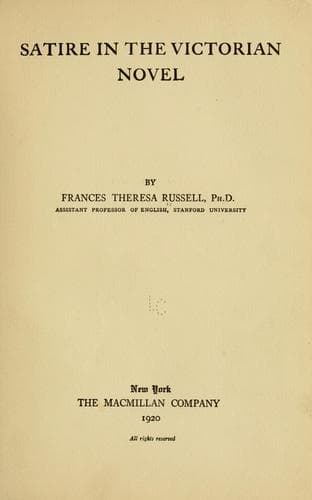
Satire in the Victorian novelRussell, Frances Theresa
History
Satire in the Victorian novel
Russell, Frances Theresa
English fiction -- 19th century -- History and criticism; Satire, English -- History and criticism; Thesis (Ph. D.)
“I loathe it: he had never kindly heart,
Nor ever cared to better his own kind,
Who first wrote satire, with no pity in it.”
Birrell,[62] less caustic than De Quincey about Pope, still uses him as
an instance of how not to do it:
“Dr. Johnson is more to my mind as a sheer satirist than Pope,
for in satire character tells more than in any other form of
verse. We want a personality behind--a strong, gloomy, brooding
personality; soured and savage, if you will * * * but spiteful
never.”
Even the traits of gloom and savagery might be dispensed with, and room
made for an infusion of sweetness and light. This is implied in the
condition laid down by Lionel Johnson:[63]
“To tilt at superstition, to shoot at folly, is seldom a
grateful or a gratifying pursuit, if there be no depth of
purpose in it, nothing but pleasure in the consciousness of
destructive power, no feeling of sympathetic pity, no tenderness
somewhere in the heart, no cordiality sweetening the work of
overthrow.”
And Garnett[64] concludes:
“Satirists have met with much ignorant and invidious
depreciation, as though a talent for ridicule was necessarily
the index of an unkindly nature. The truth is just the reverse.”
Discrimination as to objects of satire has reference not to their
nature, as foolish, vicious, deceitful, but to their legitimacy as
objects. It is a matter of taste and justice on the part of the
satirist.
The first definite reproof of heedlessness on this score is given in
the memorial tribute to Pope:[65]
“Dart not on Folly an indignant eye:
Whoe’er discharged artillery on a fly?
Deride not Vice: absurd the thought and vain,
To bind the tyger in so weak a chain.
* * * * *
The Muse’s labour then success shall crown,
When Folly feels her smile, and Vice her frown.
* * * * *
Let SATIRE then her proper object know,
And ere she strikes, be sure she strikes a foe.
Nor fondly deem the real fool confest,
Because blind _Ridicule_ conceives a jest.”
Another critic[66] of that time utters a similar caution:
“A satire should expose nothing but what is corrigible, and make
a due discrimination between those who are, and those who are
not the proper objects of it.”
The best modern expression[67] of this idea happens to be an
interpretation of a pioneer satirist. And it is distinctly modern
in its recognition that while the real object of satire must be an
abstraction,--the sin not the sinner--it must, to be artistic, have
a concrete embodiment,--the sinner rather than the sin. The Greek
dramatist explains:
Public-domain text, read in full here on John Shaqi.
Reviews
Reviews
No reviews yet
Be the first to share your thoughts on this work.
Join the Discussion
Join the discussion
Sign in to leave a comment or review.
Sign InorCreate an account