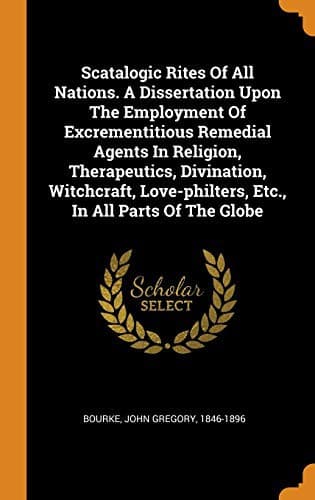
Scatalogic Rites of All Nations: A dissertation upon the employment of excrementitious remedial agents in religion, therapeutics, divination, witchcraft, love-philters, etc., in all parts of the globeBourke, John Gregory
Religion
Scatalogic Rites of All Nations: A dissertation upon the employment of excrementitious remedial agents in religion, therapeutics, divination, witchcraft, love-philters, etc., in all parts of the globe
Bourke, John Gregory
Scatology
“In pathological reversion of type, due to cerebral disease, there are
certain stages in some forms of mental disease in which some of the
actions to which you refer are not uncommon.”—(Personal letter to Captain
Bourke from Surgeon John S. Billings, U. S. Army, in charge of the Army
Medical Museum, dated Washington, D. C., April 23, 1888.)
“A boy of four years old had fouled in bed; but being much afraid of
whipping, he ate his own dung, yet he could not blot the sign out of the
sheets; wherefore, being asked by threatenings, he at length tells the
chance. But being asked of its savor, he said it was of a stinking and
somewhat sweet one.... A noble little virgin, being very desirous of her
salvation, eats her own dung, and was weak and sick. She was asked of
what savor it was, and she answered it was of a stinking and a waterishly
sweet one.” These examples Von Helmont says were personally known to him,
as was that of the painter of Brussels who, going mad, subsisted for
twenty-three days on his own excrements.—(See Von Helmont’s “Oritrika”
(English translation), London, 1662, pp. 211, 212. Von Helmont’s work is
a folio of 1161 pages.)
A French lady was in the habit of carrying about her pulverized human
excrements, which she ate, and would afterwards lick her fingers.
(Christian Franz Paullini, “Dreck Apothek,” Frankfort, 1696, p. 9.)
Paullini also gives the instance of the painter of Brussels already cited
on preceding page.
“Bouillon Lagrange, pharmacien à Paris, que ses confrères appellaient
Bouillon à Pointu, a publié un ouvrage, intitulé la Chimie du Goût,
sur la fabrication des liqueurs de table, et il donne la recette d’une
préparation qu’il appelle Eau de Mille Fleurs qui se compose de bouse de
vache, infusée dans l’eau de vie.”—(“Bibliotheca Scatalogica,” pp. 93-96.)
“As to the excrements of the cow, they are still used to form the
so-called ‘eau de mille fleurs,’ recommended by several pharmacopœias as
a remedy for cachexy.”—(“Zoological Mythology,” Angelo de Gubernatis,
London, 1874, vol. i. p. 275-277.)
Public-domain text, read in full here on John Shaqi.
Reviews
Reviews
No reviews yet
Be the first to share your thoughts on this work.
Join the Discussion
Join the discussion
Sign in to leave a comment or review.
Sign InorCreate an account