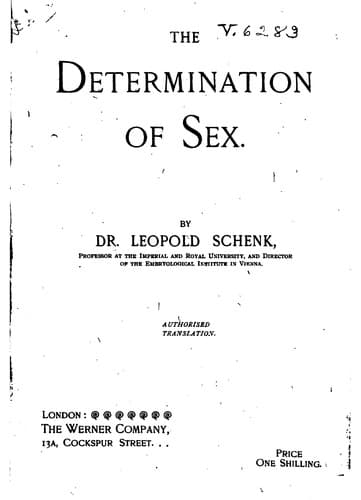
Schenk's Theory: The Determination of SexSchenk, Samuel Leopold
Science
Schenk's Theory: The Determination of Sex
Schenk, Samuel Leopold
Sex determination, Genetic; Sex preselection
A publication appeared in the year 1786 dealing with the above-mentioned
theory, and at the time attracted much attention. It has now become
difficult to procure, and is often mentioned on account of its containing
much that is valuable for influencing sex, both amongst men and animals,
that has been gathered from all the authors of the previous century, and
more especially from all the ancient authors who had written on this
subject.
The author was J. Ch. Hencke, organist at Hildesheim, and the title
of his book, ‘The Secret of Nature Completely Discovered, both in
the Procreation of Man, and for the absolute choice of the Sex of
Children.’ Brunswick, 1786. (_Völlig entdecktes Geheimniss der Natur,
sowohl in der Erzeugung des Menschen als auch in der willkürlichen Wahl
des Geschlechts der Kinder._ _Braunschweig, 1786._) The author relies
upon exploded theories, according to which the offspring is evolved,
as it were, out of a mixture of the generative secretions of the two
sexes, and can be induced to develop into either a male or female
individual. Thus the sex is not previously determined, only in the
course of its development out of the developing mass, which consists of
a mixture of male and female generative secretions, distinctive sexual
characteristics make their appearance, according to the predominance
of the male or female portion of the mixture. But here, also, the
old theory is set forth very precisely. The generative matter of the
right testicle serves to fructify ova from which males are developed,
that of the left testicle is used to fructify and develop female ova.
Similarly, the tenet is propounded that the right ovary contains male
ova and the left such only as will, when developed, produce female
offspring.
* * * * *
Public-domain text, read in full here on John Shaqi.
Reviews
Reviews
No reviews yet
Be the first to share your thoughts on this work.
Join the Discussion
Join the discussion
Sign in to leave a comment or review.
Sign InorCreate an account