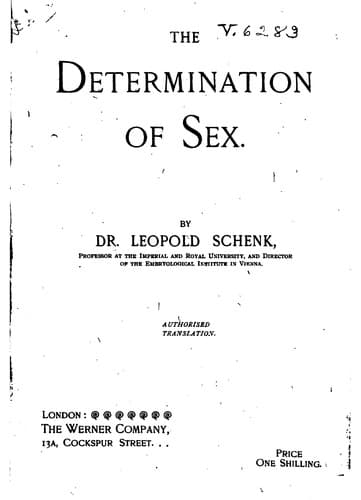
Schenk's Theory: The Determination of Sex — John Shaqi
Schenk's Theory: The Determination of SexSchenk, Samuel Leopold
Science
Schenk's Theory: The Determination of Sex
Schenk, Samuel Leopold
Sex determination, Genetic; Sex preselection
These doctrines, as a basis for the breeding of animals, Hencke had
discovered by castrating swine, dogs, and rabbits. Thus it happened
that a boar, who, after castration, had only the left testicle, twice
running bred with a sow female young only. Similar phenomena occurred
with other animals, so that this method was recommended by the author
to the breeders of his time. But it happened, also, that a surgeon
upon opening the body of a woman who had had sons only and never a
single daughter, found the left ovary very thin and withered, so that
it was hardly possible that it could serve for the development of
a new individual. On the contrary, the right ovary was in a normal
condition. It now remained only to discover some device for man,
by which he might be able, during the act of generation, to avail
himself of the discoveries thus made, so as to obtain the result of an
absolute choice of the sex of the offspring. The ligation of one of the
testicles was Hencke’s infallible remedy. When this severe proceeding
proved impracticable, in its place was substituted an elevation of
the testicle by means of its suspending muscle (the cremaster). Under
certain conditions this takes place of itself in particular positions,
and was accordingly recommended as an established proceeding for men.
One other conclusion of Hencke’s deserves particular mention. He was
bold enough not only to assert that the right and left sexual glands
served exclusively for the generation of male and female individuals,
respectively, but also asserted that the generative matter from the
right or left gland of one parent was productive only when united with
that of the same gland of the other parent. His counsels were not for
such persons as are too heated, too ardent. “For young, hot, hasty
men,” he says, “who are altogether without consideration, I am not
writing; but for chaste married people, and especially for those to
whom the production of a child of one or the other sex is a matter of
importance.”
* * * * *
Public-domain text, read in full here on John Shaqi.
Reviews
Reviews
No reviews yet
Be the first to share your thoughts on this work.
Join the Discussion
Join the discussion
Sign in to leave a comment or review.
Sign InorCreate an account