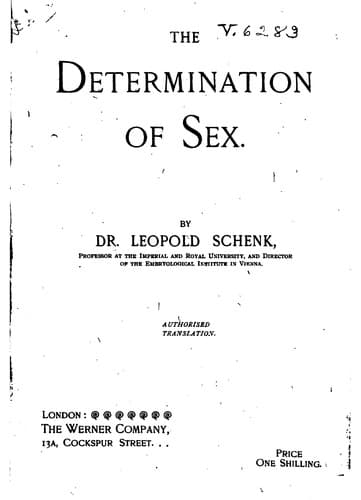
Schenk's Theory: The Determination of Sex — John Shaqi
Schenk's Theory: The Determination of SexSchenk, Samuel Leopold
Science
Schenk's Theory: The Determination of Sex
Schenk, Samuel Leopold
Sex determination, Genetic; Sex preselection
Couteau established the fact that each seminal duct had its own
orifice, through which the semen was poured into the urethra. This
fact was in his days of the greatest importance, as it prevented any
mixture of the semen of a man’s two testicles. Hencke firmly insisted
that the semen was discharged by one testicle or seminal vesicle
alone, in the case when the testicle was raised up. But we need not
here follow further Hencke’s theories which he deduced from his own
experiments. In the present day these theories will satisfy no one.
Results which have been obtained either after ovariotomy, or after the
extirpation of testicles, have made us perfectly certain about the
value of one or the other generative gland for the production of the
male or female sex. The case of Schatz, which has been also pointed to
us as important in other specialist works, may not be uninteresting
here. The left ovary of a young girl was removed, together with a
portion of the left tube, and the right ovary, also, with the exception
of a margin of about two millimetres’ breadth. When she was married she
gave birth to a girl, whereas a boy should have been expected, seeing
that only male offspring were to be produced by the right ovary.
Scarcely any work that lies before us on this subject is so much
regarded as that of Hencke. At the same time, and although it had
in its day the widest circulation, it frequently met with the most
unqualified condemnation. Dr. von Seligson, in his discourse before the
Society of Medical Practitioners at Moscow (1895), on the subject of
influencing the development of sex, in connection with Hencke’s theory,
attached value to a great number of experiments tending to support the
old view. It was, however, admitted that by a departure of nature from
the ordinary law (somewhat resembling a transposition of the viscera)
male or female ova might occur in the respectively opposite ovaries.
* * * * *
De Bay, who was opposed to the theory of the anteriorly-developed
sexual products of the right and left ovaries, asserts that the
quality of the generative products depends upon the quantity of
nitrogen existing in the chemical composition of the ovum and the
semen. A large proportion of nitrogen in the ovum occasions the
development of a girl. If, on the contrary, the semen contains a great
quantity of nitrogen, a male individual will result. To determine the
proportion of nitrogen, or to give it scientific value in such cases,
seems to be a difficult matter.
* * * * *
Public-domain text, read in full here on John Shaqi.
Reviews
Reviews
No reviews yet
Be the first to share your thoughts on this work.
Join the Discussion
Join the discussion
Sign in to leave a comment or review.
Sign InorCreate an account