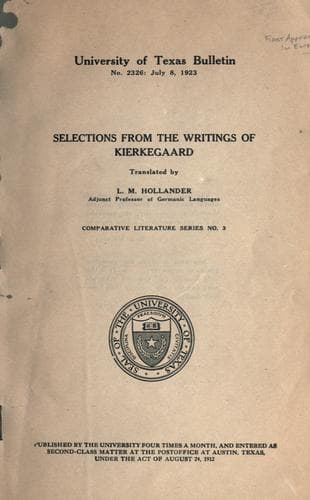
Selections from the Writings of Kierkegaard — John Shaqi
Selections from the Writings of KierkegaardKierkegaard, Søren
Religion
Selections from the Writings of Kierkegaard
Kierkegaard, Søren
Philosophy; Theology
During the first half of the nineteenth century, more than at any
other time, Denmark was an intellectual dependency of Germany. It
was but natural that Kierkegaard, in search for the ultimate verities,
should resort to Berlin where Schelling was just then beginning his
famous course of lectures. In many respects it may be held deplorable
that, at a still formative stage, Kierkegaard should have remained in
the prosaic capital of Prussia and have been influenced by bloodless
abstractions; instead of journeying to France, or still better, to
England whose empiricism would, no doubt, have been an excellent
corrective of his excessive tendency to speculation. In fact he was
quickly disappointed with Schelling and after four months returned
to his beloved Copenhagen (which he was not to leave thereafter
except for short periods), with his mind still busy on the problems
which were peculiarly his own. The tremendous impulse given by his
unfortunate engagement was sufficient to stimulate his sensitive mind
to a productivity without equal in Danish literature, to create a
"literature within a literature." The fearful inner collision
of motives had lit an inner conflagration which did not die down for
years. "My becoming an author is due chiefly to her, my melancholy,
and my money."
About a year afterwards (1843) there appeared his first great work,
"Either-Or," which at once established his fame. As in the case of most
of his works it will be impossible to give here more than the barest
outline of its plan and contents. In substance, it is a grand debate
between the æsthetic and the ethic views of life. In his dissertation
Kierkegaard had already characterized the æsthetic point of view. Now,
in a brilliant series of articles, he proceeds' to exemplify it with
exuberant detail.
The fundamental chord of the first part is struck in the _Diapsalmata_
aphorisms which, like so many flashes of a lantern, illuminate
the æsthetic life, its pleasures and its despair. The æsthetic
individual--this is brought out in the article entitled "The Art of
Rotation"--wishes to be the exception in human society, shirking its
common, humble duties and claiming special privileges. He has no fixed
principle except that he means not to be bound to anything or anybody.
He has but one desire which is, to enjoy the sweets of life--whether
its purely sensual pleasures or the more refined Epicureanism of the
finer things in life and art, and the ironic enjoyment of one's own
superiority over the rest of humanity; and he has no fear except that
he may succumb to boredom.
Public-domain text, read in full here on John Shaqi.
Reviews
Reviews
No reviews yet
Be the first to share your thoughts on this work.
Join the Discussion
Join the discussion
Sign in to leave a comment or review.
Sign InorCreate an account