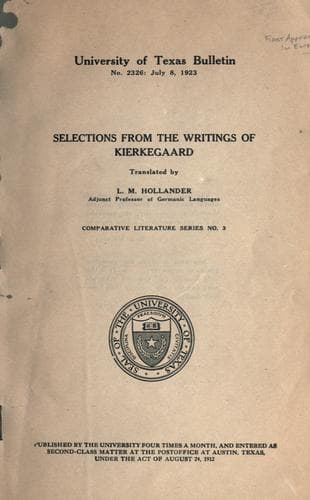
Selections from the Writings of KierkegaardKierkegaard, Søren
Religion
Selections from the Writings of Kierkegaard
Kierkegaard, Søren
Philosophy; Theology
As a comment on this text there follow a number of essays in
"experimental psychology," supposed to be the fruit of the æsthete's
(A's) leisure. In them the æsthetic life is exhibited in its various
manifestations, in "terms of existence," especially as to its "erotic
stages," from the indefinite longings of the Page to the fully conscious
"sensual genius" of Don Juan--the examples are taken from Mozart's
opera of this name, which was Kierkegaard's favorite--until the
whole culminates in the famous "Diary of the Seducer," containing
elements of the author's own engagement, poetically disguised--a
seducer, by the way, of an infinitely reflective kind.
Following this climax of unrestrained æstheticism we hear in the
second part the stern demands of the ethical life. Its spokesman, Judge
William, rises in defense of the social institutes, and of marriage in
particular, against the slurs cast on them by his young friend A. He
makes it clear that the only possible outcome of the æsthetic life,
with its aimlessness, its superciliousness, its vague possibilities,
is a feeling of vanity and vexation of spirit, and a hatred of life
itself: despair. One floundering in this inevitable slough of despond,
who earnestly wishes to escape from it and to save himself from the
ultimate destruction of his personality, must choose and determine to
rise into the ethical sphere. That is, he must elect a definite calling,
no matter how humdrum, marry, if possible, and thus subject himself
to the "general law." In a word, instead of a world of vague
possibilities, however attractive, he must choose the definite
circumscription of the individual who is a member of society. Only
thus will he obtain a balance in his life between the demands of his
personality on the one hand, and of the demands of society on him.
When thus reconciled to his environment--his "lot"--all the
pleasures of the æsthetic sphere which he resigned will be his again
in rich measure, but in a transfigured sense.
Public-domain text, read in full here on John Shaqi.
Reviews
Reviews
No reviews yet
Be the first to share your thoughts on this work.
Join the Discussion
Join the discussion
Sign in to leave a comment or review.
Sign InorCreate an account