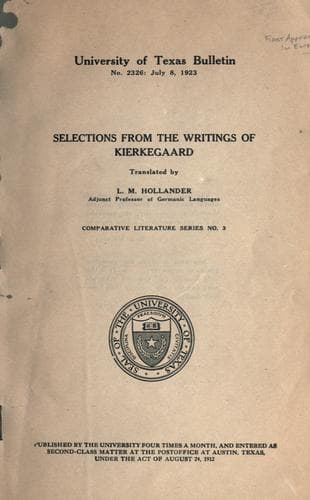
Selections from the Writings of KierkegaardKierkegaard, Søren
Religion
Selections from the Writings of Kierkegaard
Kierkegaard, Søren
Philosophy; Theology
Difficulties arose very soon. It was not so much the extreme youth
and immaturity of the girl--she was barely sixteen--as against his
tremendous mental development, or even her "total lack of religious
pre-suppositions"; for that might not itself have precluded a happy
union. Vastly more ominous was his own unconquerable and overwhelming
melancholy. She could not break it. And struggle as he might, he
could not banish it. And, he reasoned, even if he were successful
in concealing it from her, the very concealment were a deceit. Neither
would he burden her with his melancholy by revealing it to her.
Besides, some mysterious ailment which, with Paul, he terms the "thorn
in his flesh," tormented him. The fact that he consulted a physician
makes it likely that it was bodily, and perhaps sexual. On the other
hand, the manner of Kierkegaard's multitudinous references to woman
removes the suspicion of any abnormality. The impression remains that
at the bottom of his trouble there lay his melancholy, aggravated
admittedly by an "insane education," and coupled with an exaggerated
sense of a misspent youth. That nothing else prevented the union
is clear from his own repeated later remarks that, with more faith,
he would have married her.
Though to the end of his life he never ceased to love her, he
feels that they must part. But she clings to him with a rather maudlin
devotion, which, to be sure, only increased his determination. He
finally hit on the desperate device of pretending frivolous indifference
to her affections, and acted this sad comedy with all the dialectic
subtleness of his genius, until she eventually released him. Then,
after braving for a while the philistine indignation of public opinion
and the disapproval of his friends, in order to confirm her in her bad
opinion of him, he fled to Berlin with shattered nerves and a bleeding
heart.
He had deprived himself of what was dearest to him in life. For
all that, he knew that the foundations of his character remained
unshaken. The voluntary renunciation of a worldly happiness which
was his for the taking intensifies his idea of being one of the "few
in each generation selected to be a sacrifice." Thereafter, "his thought
is all to him," and all his gifts are devoted to the service of God.
Public-domain text, read in full here on John Shaqi.
Reviews
Reviews
No reviews yet
Be the first to share your thoughts on this work.
Join the Discussion
Join the discussion
Sign in to leave a comment or review.
Sign InorCreate an account