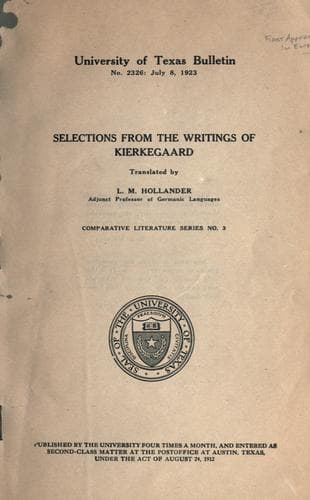
Selections from the Writings of KierkegaardKierkegaard, Søren
Religion
Selections from the Writings of Kierkegaard
Kierkegaard, Søren
Philosophy; Theology
Though nobly eloquent in places, and instinct with warm feeling,
this panegyric on marriage and the fixed duties of life is somewhat
unconvincing, and its style undeniably tame and unctious--at
least when contrasted with the Satanic verve of most of A's papers.
The fact is that Kierkegaard, when considering the ethical sphere, in
order to carry out his plan of contrasting it with the æsthetic sphere,
was already envisaging the higher sphere of religion, to which the
ethical sphere is but a transition, and which is the only true
alternative to the æsthetic life. At the very end of the book
Kierkegaard, flying his true colors, places a sermon as an "ultimatum,"
purporting to have been written by a pastor on the Jutish Heath. Its
text is that "as against God we are always in the wrong," and the tenor
of it, "only that truth which edifies is truth for you." It is not that
you must choose either the æsthetic or the ethical view of life; but
that neither the one nor the other is the full truth--God alone is the
truth which must be grasped with all inwardness. But since we recognize
our imperfections, or sins, the more keenly, as we are developed more
highly, our typical relation to God must be that of repentance; and by
repentance as by a step we may rise into the higher sphere of
religion--as will be seen, a purely Christian thought.
A work of such powerful originality, imposing by its very size, and
published at the anonymous author's own expense, could not but create
a stir among the small Danish reading public. And notwithstanding
Kierkegaard's consistent efforts to conceal his authorship in the
interest of his "indirect communication," it could not long remain a
secret. The book was much, and perplexedly, discussed, though no one
was able to fathom the author's real aim, most readers being attracted
by piquant subjects such as the "Diary of the Seducer," and regarding
the latter half as a feeble afterthought. As he said himself: "With my
left hand I held out to the world 'Either-Or,' with my right, 'Two
Edifying Discourses'; but they all--or practically all--seized
with their right hands what I held in my left."
These "Two Edifying Discourses[4]"--for thus he preferred to call
them, rather than sermons, because he claimed no authority to
preach--as well as all the many later ones, were published over
his own name, addressed to Den Enkelte "The Single Individual whom
with joy and gratitude he calls his reader," and were dedicated to the
memory of his father. They belong among the noblest books of
edification, of which the North has not a few.
Public-domain text, read in full here on John Shaqi.
Reviews
Reviews
No reviews yet
Be the first to share your thoughts on this work.
Join the Discussion
Join the discussion
Sign in to leave a comment or review.
Sign InorCreate an account