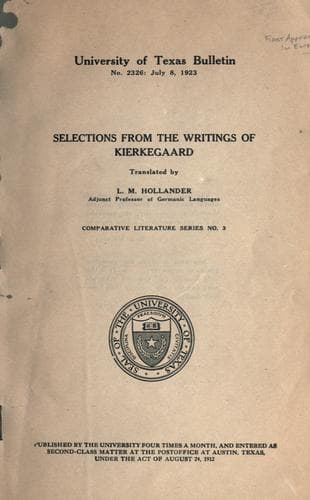
Selections from the Writings of KierkegaardKierkegaard, Søren
Religion
Selections from the Writings of Kierkegaard
Kierkegaard, Søren
Philosophy; Theology
During the following three years (1843-5) Kierkegaard, once roused
to productivity, though undoubtedly kept at his task by the exertion of
marvelous will-power, wrote in quick succession some of his most
notable works--so original in form, in thought, in content that
it is a well-nigh hopeless task to analyze them to any satisfaction.
All we can do here is to note the development in them of the one grand
theme which is fundamental to all his literary activity: how to become
a Christian.
If the second part of "Either-Or" was devoted to an explanation of
the nature of the ethical, as against the æsthetic, conduct of life,
inevitably the next task was, first, to define the nature of the
religious life, as against the merely ethical life; then, to show how
the religious sphere may be attained. This is done in the brilliant twin
books _Frygt og Baeven_ "Fear and Trembling" and _Gjentagelsen_
"Repetition." Both were published over pseudonyms.
"Fear and Trembling" bears as its subtitle "Dialectic Lyrics."
Indeed, nowhere perhaps is Kierkegaard's strange union of dialectic
subtlety and intense lyrical power and passion so strikingly in evidence
as in this panegyric on Abraham, the father of faith. To Kierkegaard
he is the shining exemplar of the religious life; and his greatest act
of faith, his obedience to God's command to slay Isaac. Nothing can
surpass the eloquence with which he depicts the agony of the father,
his struggle between the ethical, or general, law which, saith "thou
shalt no kill"! and God's specific command. In the end, Abraham by a
grand resolve transgresses the law; and lo! because he has faith,
against certainty, that he will keep Isaac, and does not merely resign
him, as many a tragic hero would have done, he receives all again, in
a new and higher sphere. In other words, Abraham chooses to be "the
exception" and set aside the general law, as well as does the æsthetic
individual; but, note well: "in fear and trembling," and at the express
command of God! He is a "knight of faith." But because this direct
relation to the divinity necessarily can be certain only to Abraham's
self, his action is altogether incomprehensible to others. Reason
recoils before the absolute paradox of the individual who chooses
to rise superior to the general law.
Public-domain text, read in full here on John Shaqi.
Reviews
Reviews
No reviews yet
Be the first to share your thoughts on this work.
Join the Discussion
Join the discussion
Sign in to leave a comment or review.
Sign InorCreate an account