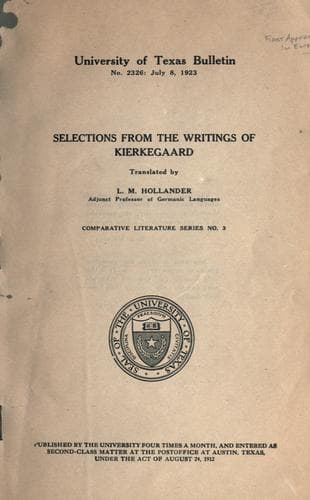
Selections from the Writings of KierkegaardKierkegaard, Søren
Religion
Selections from the Writings of Kierkegaard
Kierkegaard, Søren
Philosophy; Theology
The rise into the religious sphere is always likely to be the outcome
of some severe inner conflict engendering infinite passion. In the
splendidly written _Gjentagelse_ "Repetition" we are shown _ad oculos_
an abortive transition into the religious sphere, with a corresponding
relapse into the æsthetic sphere. Kierkegaard's own love-story is again
drawn upon: the "Young Person" ardently loves the woman; but discovers
to his consternation that she is in reality but a burden to him since,
instead of having an actual, living relation to her, he merely
"remembers" her when she is present. In the ensuing collision of motives
his æsthetically cool friend Constantin Constantius advises him to act
as one unworthy of her--as did Kierkegaard--and to forget her. But
instead of following this advice, and lacking a deeper religious
background, he flees the town and subsequently transmutes his trials
into poetry--that is, relapses into the æsthetic sphere: rather than,
like Job, whom he apostrophises passionately, "receiving all again"
(having all "repeated") in a higher sphere. This idea of the resumption
of a lower stage into a higher one is one of Kierkegaard's most original
and fertile thoughts. It is illustrated here with an amazing wealth of
instances.
So far, it had been a question of religious feeling in general--how it
may arise, and what its nature is. In the pivotal work _Philosophiske
Smuler_ "Philosophic Trifles"--note the irony--Kierkegaard throws
the searching rays of his penetrating intellect on the grand problem
of revealed religion: can one's eternal salvation be based on
an historical event? This is the great stumbling block to the
understanding.
Hegel's philosophic optimism maintained that the difficulties of
Christianity had been completely "reconciled" or "mediated" in the
supposedly higher synthesis of philosophy, by which process religion
had been reduced to terms which might be grasped by the intellect.
Kierkegaard, fully voicing the claim both of the intellect and of
religion, erects the barrier of the paradox, impassable except by
the act of faith. As will be seen, this is Tertullian's _Credo
quia absurdum._[5]
Public-domain text, read in full here on John Shaqi.
Reviews
Reviews
No reviews yet
Be the first to share your thoughts on this work.
Join the Discussion
Join the discussion
Sign in to leave a comment or review.
Sign InorCreate an account