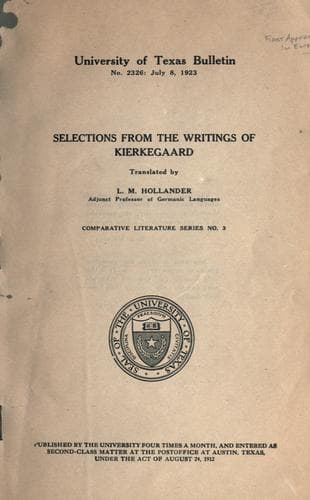
Selections from the Writings of KierkegaardKierkegaard, Søren
Religion
Selections from the Writings of Kierkegaard
Kierkegaard, Søren
Philosophy; Theology
In the briefest possible outline his argument is as follows:
Socrates had taught that in reality every one had the truth in him
and needed but to be reminded of it by the teacher who thus is
necessary only in helping the disciple to discover it himself. That is
the indirect communication of the truth. But now suppose that the
truth is not innate in man, suppose he has merely the ability to
grasp it when presented to him. And suppose the teacher to be of
absolute, infinite importance--the Godhead himself, directly
communicating with man, revealing the truth in the shape of man; in
fact, as the lowliest of men, yet insisting on implicit belief in Him!
This, according to Kierkegaard, constitutes the paradox of faith
_par excellence._ But this paradox, he shows, existed for the
generation contemporaneous with Christ in the same manner as it does
for those living now. To think that faith was an easier matter for
those who saw the Lord and walked in His blessed company is but a
sentimental, and fatal, delusion. On the other hand, to found one's
faith on the glorious results, now evident, of Christ's appearance in
the world is sheer thoughtlessness and blasphemy. With ineluctable
cogency it follows that "there can be no disciple at second hand."
Now, as well as "1800 years ago," whether in Heathendom or in
Christendom, faith is born of the same conditions: the resolute
acceptance by the individual of the absolute paradox.
In previous works Kierkegaard had already intimated that what
furnished man the impetus to rise into the highest sphere and to
assail passionately and incessantly the barrier of the paradox, or else
caused him to lapse into "demonic despair," was the consciousness of
sin. In the book _Begrebet Angest_ "The Concept of Sin," he now
attempts with an infinite and laborious subtlety to explain the nature
of sin. Its origin is found in the "sympathetic antipathy" of
Dread--that force which at one and the same time attracts and
repels from the suspected danger of a fall and is present even in the
state of innocence, in children. It finally results in a kind of
"dizziness" which is fatal. Yet, so Kierkegaard contends, the "fall"
of man is, in every single instance, due to a definite act of the will,
a "leap"--which seems a patent contradiction.
To the modern reader, this is the least palatable of Kierkegaard's
works, conceived as it is with a sovereign and almost medieval
disregard of the predisposing undeniable factors of environment and
heredity (which, to be sure, poorly fit his notion of the absolute
responsibility of the individual). Its somberness is redeemed, to a
certain degree, by a series of marvelous observations, drawn from
history and literature, on the various phases and manifestations
of Dread in human life.
Public-domain text, read in full here on John Shaqi.
Reviews
Reviews
No reviews yet
Be the first to share your thoughts on this work.
Join the Discussion
Join the discussion
Sign in to leave a comment or review.
Sign InorCreate an account