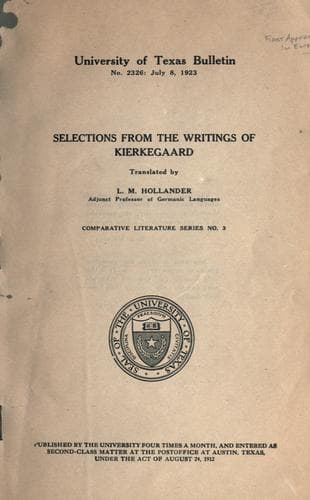
Selections from the Writings of KierkegaardKierkegaard, Søren
Religion
Selections from the Writings of Kierkegaard
Kierkegaard, Søren
Philosophy; Theology
Kierkegaard makes less (and rather too little) of the positive side
of Socrates' method, his _maieutic_, or midwifery, by which we
are led inductively from trivial instances to a new definition of a
conception, a method which will fit all cases. Guided by a lofty
personality, this Socratic irony becomes, in Kierkegaard's definition,
merely "the negative liberation of subjectivity"; that is, not the
family, nor society, nor the state, nor any rules superimposed from
outside, but one's innermost self (or subjectivity) is to be the
determining factor in one's life. And understood thus, irony as a
negative element borders on the ethical conception of life.
Romantic irony, on the other hand, laying main stress on subjective
liberty, represents the æsthetic conduct of life. It was, we remember,
the great demand of the Romantic period that one live poetically. That
is, after having reduced all reality to possibilities, all existence to
fragments, we are to choose _ad libitum_ one such possible existence,
to consider that one's proper sphere, and for the rest to look
ironically on all other reality as philistine. Undeniably, this license,
through the infinitude of possibilities open to him, gives the ironist
an enthusiastic sense of irresponsible freedom in which he "disports
himself as does Leviathan in the deep." Again, the "æsthetical
individual" is ill at ease in the world into which he is born. His
typical ailment is a Byronesque _Weltschmerz._ He would fain mould
the elements of existence to suit himself; that, is, "compose" not
only himself but also his surroundings. But without fixed task and
purpose, life will soon lose all continuity ("except that of boredom")
and fall apart into disconnected moods and impulses. Hence, while
supposing himself a superman, free, and his own master, the æsthetic
individual is, in reality, a slave to the merest accidents. He is not
self-directed, self-propelled; but--drifts.
Over against this attitude Kierkegaard now sets the ethical,
Christian life, one with a definite purpose and goal beyond itself.
"It is one thing to compose one's own life, another, to let one's life
be composed. The Christian lets his life be composed; and insofar a
simple Christian lives far more poetically than many a genius." It
would hardly be possible to characterize the contents of Kierkegaard's
first great book, _Enten-Eller_ "Either-Or," more inclusively
and tersely.
Public-domain text, read in full here on John Shaqi.
Reviews
Reviews
No reviews yet
Be the first to share your thoughts on this work.
Join the Discussion
Join the discussion
Sign in to leave a comment or review.
Sign InorCreate an account