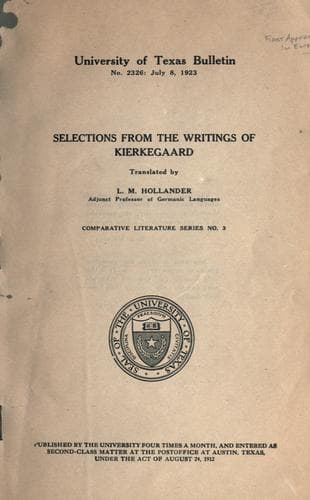
Selections from the Writings of KierkegaardKierkegaard, Søren
Religion
Selections from the Writings of Kierkegaard
Kierkegaard, Søren
Philosophy; Theology
Very well, then, the Christian life, with its clear directive, is
superior to the æsthetic existence. But how is this: are we not all
Christians in Christendom, children of Christians, baptized and
confirmed according to the regulations of the Church? And are we
not all to be saved according to the promise of Our Lord who died for
us? At a very early time Kierkegaard, himself desperately struggling to
maintain his Christian faith against doubts, had his eyes opened to this
enormous delusion of modern times and was preparing to battle against
it. The great idea and task for which he was to live and to die--here
it was: humanity is in apparent possession of the divine truth, but
utterly perverts it and, to cap injury with insult, protects and
intrenches the deception behind state sanction and institutions. More
appalling evil confronted not even the early protagonists of
Christianity against heathendom. How was he, single-handed,
magnificently gifted though he was, to cleanse the temple and restore
its pristine simplicity?
Clearly, the old mistake must not be repeated, to try to influence
and reform the masses by a vulgar and futile "revival," preaching to
them directly and gaining disciples innumerable. It would only lead
again, to the abomination of a lip service. But a ferment must be
introduced which--he hoped--would gradually restore Christianity to
its former vigor; at least in individuals. So far as the form of his
own works is concerned he was thus bound to use the "indirect method"
of Socrates whom he regards as his teacher. In conscious opposition to
the Sophists who sold their boasted wisdom for money, Socrates not
only made no charges for his instruction but even warned people of his
ignorance, insisting that, like a midwife, he only helped people to
give birth to their own thoughts. And owing to his irony Socrates'
relation to his disciples was not in any positive sense a personal one.
Least of all did he wish to found a new "school" or erect a philosophic
"system."
Public-domain text, read in full here on John Shaqi.
Reviews
Reviews
No reviews yet
Be the first to share your thoughts on this work.
Join the Discussion
Join the discussion
Sign in to leave a comment or review.
Sign InorCreate an account