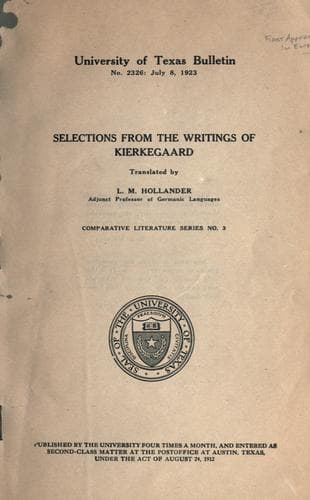
Selections from the Writings of KierkegaardKierkegaard, Søren
Religion
Selections from the Writings of Kierkegaard
Kierkegaard, Søren
Philosophy; Theology
Kierkegaard, with Christianity as his goal, adopted the same
tactics. By an attractive æsthetic beginning people were to be "lured"
into envisaging the difficulties to be unfolded presently, to think for
themselves, to form their own conclusions, whether for or against. The
individual was to be appealed to, first and last--the individual,
no matter how humble, who would take the trouble to follow him and
be his reader, "my only reader, the single individual. So the
religious author must make it his first business to put himself in touch
with men. That is to say, he must begin æsthetically. The more brilliant
his performance, the better." And then, when he has got them to follow
him "he must produce the religious categories so that these same men
with all the impetus of their devotion to æsthetic things are suddenly
brought up sharp against the religious aspect." The writer's own
personality was to be entirely eliminated by a system of pseudonyms;
for the effect of his teaching was not to be jeopardized by a
distracting knowledge of his personality. Accordingly, in conscious
imitation of Socrates, Kierkegaard at first kept up a semblance of his
previous student life, posing as a frivolous idler on the streets of
Copenhagen, a witty dog incapable of prolonged serious activity; thus
anxiously guarding the secret of his feverish activity during the lonely
hours of the night.
His campaign of the "indirect communication" was thus fully
determined upon; but there was still lacking the impetus of an elemental
passion to start it and give it driving force and conquering persistence.
This also was to be furnished him.
Shortly before his father's death he had made the acquaintance of
Regine Olson, a beautiful young girl of good family. There followed one
of the saddest imaginable engagements. The melancholy, and essentially
lonely, thinker may not at first have entertained the thought of a
lasting attachment; for had he not, on the one hand, given up all
hope of worldly happiness, and on the other, begun to think of himself
as a chosen tool of heaven not to be bound by the ordinary ties of
human affection? But the natural desire to be as happy as others and to
live man's common lot, for a moment hushed all anxious scruples. And
the love of the brilliant and promising young man with the deep,
sad eyes and the flashing wit was ardently returned by her.
Public-domain text, read in full here on John Shaqi.
Reviews
Reviews
No reviews yet
Be the first to share your thoughts on this work.
Join the Discussion
Join the discussion
Sign in to leave a comment or review.
Sign InorCreate an account