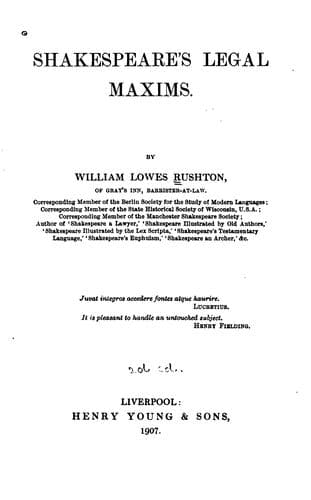
Law in literature; Shakespeare, William, 1564-1616 -- Knowledge -- Law
The Lord Chancellor (a cancellando, from his power to cancel letters
patent, being the highest point of his jurisdiction) or Lord Keeper, is
the chief judge in the extraordinary Court of Equity, as well as in the
ordinary Court of Common Law (4 Inst. 79, 82, 88, Wood’s Inst. 2nd ed.
pp. 459, 460). He is not made by letters patent, but by the delivery of
the Great or Broad Seal to him, and by taking an oath to serve the king
and his people faithfully in the office of Lord Chancellor (4 Inst. 87).
He is made Lord Chancellor of England or Lord Keeper of the Great Seal,
per traditionem magni sigilli sibi per dominum regem, and by taking his
oath forma cancellarium constituendi regnante Henrico Secundo fuit
appendendo magnum Angliæ sigillum ad collum cancellarii electi (Camden,
p. 131). Thus the delivery of the king’s seal or the taking it away,
alluded to by Shakespeare in this passage, is the ceremony used in making
or unmaking a Lord Chancellor. Some have gotten it by letters patent at
will (35 Hen. VI. 3 b. of Winch., I Hen. VI. sec. 16) and one for term of
his life (Cardinal Wolsey); but it was holden void, because an ancient
office must be granted as it hath been accustomed (4 Inst. 87).
_Ant. E._ What, will you murder me? Thou gaoler, thou,
I am thy prisoner: wilt thou suffer them
To make a rescue?
_Off._ Masters, let him go:
He is my prisoner, and you shall not have him.
_Pinch._ Go bind this man, for he is frantic too.
_Adr._ What wilt thou do, thou peevish officer?
Hast thou delight to see a wretched man
Do outrage and displeasure to himself?
_Off._ He is my prisoner: if I let him go,
The debt he owes will be requir’d of me.
_Comedy of Errors_, Act iv. Scene 4.
Public-domain text, read in full here on John Shaqi.
Reviews
Reviews
No reviews yet
Be the first to share your thoughts on this work.
Join the Discussion
Join the discussion
Sign in to leave a comment or review.
Sign InorCreate an account