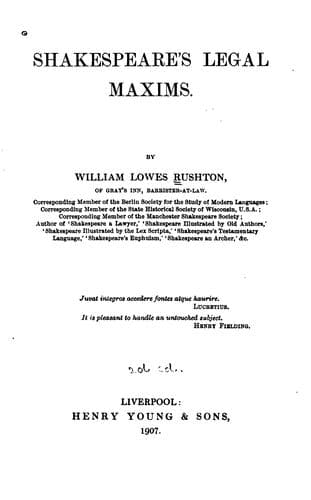
Law in literature; Shakespeare, William, 1564-1616 -- Knowledge -- Law
Dormiunt aliquando leges, moriuntur nunquam. The laws sometimes sleep,
they never die. Although it was a maxim of the civil law that as laws
might be established by custom, they could likewise become obsolete by
disuse or be abrogated by contrary usage, Ea vero quæ ipsa sibi quæque
civitas constituit sæpe mutari solent vel tacito consensu populi vel
aliâ posteâ, lege latâ (I. L. 2, 11, Irving, Civil Law, 4th ed., 123):
and by the law of Scotland a statute is said to lose its force by
disuse (Stair, Macdonal, Wallace), if it has not been in execution for
sixty years, and, according to some Scotch lawyers for a hundred years,
and a distinction is made between statutes which are as it were half
obsolete and those in viridi observantiâ, yet by the law of England every
statute continues in force until it is repealed by a subsequent Act of
Parliament. Lex Angliæ sine parliamento mutari non potest (2 Institute,
619), for nothing is so agreeable to natural equity as that everything
should be dissolved by the same means which made it binding. Nihil tam
conveniens est naturali æquitati quam unumquodque dissolvi eo ligamine
quo ligatum est (2 Institute, 360).
The statutes can only be altered or repealed by the same authority by
which they were made—jura eodem modo distituuntur quo constituuntur
(Dwarr. Stats. 672), eodem ligamine quo ligatum est dissolvitur (Co.
Litt. 212b).
_Wolsey._ That seal
You ask with such a violence, the king
(Mine and your master) with _his own hand gave me_;
Bad me enjoy it, with the place and honours,
During my life; and to confirm his goodness,
Tied it by letters-patents:—now, who’ll take it?
_Sur._ The king, that gave it.
_Wol._ It must be himself, then.
_Henry VIII._, Act iii. Scene 2.
Public-domain text, read in full here on John Shaqi.
Reviews
Reviews
No reviews yet
Be the first to share your thoughts on this work.
Join the Discussion
Join the discussion
Sign in to leave a comment or review.
Sign InorCreate an account