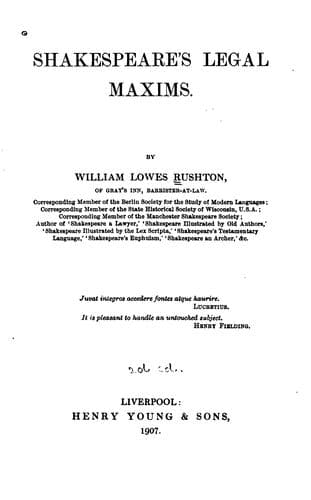
Law in literature; Shakespeare, William, 1564-1616 -- Knowledge -- Law
If a sheriff or a gaoler suffers a prisoner, who is taken upon mesne
process (that is, during the pendency of a suit) to escape, he is liable
to an action on the case (Cro. Eliz., 625). But if after judgment
a gaoler or a sheriff permit a debtor to escape, who is charged in
execution for a certain sum, the debt immediately becomes his own, and
he is compellable by an action of debt, being for a liquated sum and
ascertained, to satisfy the creditor his whole demand; which doctrine is
grounded on the Equity of the Statute of Westminster second (13 Edw. I.
c. 11, and I. Rich. II. c. 12. Bro. Alr. t. parliament, 192; Inst. 382;
3 Bla. Com. 165), ubi jus ibi remedium (I. T. R. 512). There is no wrong
without a remedy. Jus, in the sense in which it is used in this maxim,
signifies ‘the legal authority to do or to demand something’ (Mackfield,
Civ. Law, 6). Remedium may be defined to be the right of action, or the
means given by law for the recovery of a right, and, according to this
maxim, whenever the law gives anything, it gives a remedy for the same;
Lex semper dabit remedium (Jacob, Law Dic. title Remedy, Bac. Alr.,
actions in general). Every injury to a legal right necessarily imports
damage in the nature of it, though there be no pecuniary loss (per Holt,
C. J., Ashly v. White, 2 Lord Raymond). Thus where a prisoner is in
execution or final process, the creditor has a right to the body of his
debtor every hour till the debt is paid; and an escape of the debtor, for
ever so short a time, is necessarily a damage to him, and an action for
an escape lies (Williams v. Mostyn, 4 M. & W. 153; Wylie v. Birch, 4 Qu.
B. 566, 567; Clifton v. Hooper, 6 Qu. B. 468).
_York._ I took an oath that he should quietly reign.
_Edw._ But, for a kingdom, any oath may be broken:
I would break a thousand oaths to reign one year.
_Rich._ No; God forbid, your grace should be forsworn.
_York._ I shall be, if I claim by open war.
_Rich._ I’ll prove the contrary, if you’ll hear me speak.
_York._ Thou canst not, son; it is impossible.
_Rich._ An oath is of no moment, being not took
Before a true and lawful magistrate,
That hath authority over him that swears:
Henry had none, but did usurp the place;
Then, seeing ’twas he that made you to depose,
Your oath, my lord, is vain and frivolous.
Therefore, to arms.
3 _Henry VI._, Act i. Scene 2.
Public-domain text, read in full here on John Shaqi.
Reviews
Reviews
No reviews yet
Be the first to share your thoughts on this work.
Join the Discussion
Join the discussion
Sign in to leave a comment or review.
Sign InorCreate an account