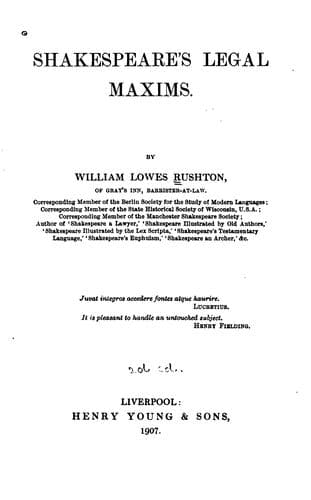
Law in literature; Shakespeare, William, 1564-1616 -- Knowledge -- Law
An oath is an affirmation or denial of anything _before one that hath
authority to administer the same_, calling God to witness that his
testimony is true (3 Inst. 165, C. 74). Sacramentum, habet in se tres
comites, veritatem, justiciam et judicium; veritas habenda est in
juratore; justicia et judicium in judice (Bracton, I. 4, f. 186). Four
sorts of oaths have been enumerated, viz., Juramentum promissionis, where
an oath is taken to do or not to do such a thing (it appears that York
had taken an oath of this description); Juramentum purgationis, which is
where a person is charged with any matter by bill in Equity; Juramentum
probationis, where one is produced as a witness to prove or disprove a
thing; and Juramentum triationis, where one is sworn to try the issue,
such as a juror. The oath must be lawful, allowed by the common law or
some Act of Parliament; so Salisbury says—
_Sal._ It is a great sin to swear unto a sin;
But greater sin to keep a sinful oath.
Who can be bound by any solemn vow
To do a murd’rous deed, to rob a man,
To force a spotless virgin’s chastity,
To reave the orphan of his patrimony,
To wring the widow from her custom’d right;
And have no other reason for this wrong,
But that he was bound by a solemn oath?
2 _Henry VI._, Act v. Scene 1.
and it must be taken before one that hath authority, not before a person
acting in a private capacity, or pretending to have authority where he
hath none; nor by one that goes beyond the authority which was granted.
For such false oaths cannot amount to perjury in law, because they are of
no validity, being coram non judice (3 Institute, 165; 4 Institute, 278,
279; 2 Roll. Alr. 257; Wood’s Institute, 2nd ed., pp. 411, 412).
_Car._ The commons hast thou rack’d; the clergy’s bags
Are lank and lean with thy extortions.
_Som._ Thy sumptuous buildings, and thy wife’s attire,
Have cost a mass of public treasury.
_Buck._ Thy cruelty in execution
Upon offenders, hath exceeded law,
And left thee to the mercy of the law.
2 _Henry VI._, Act i. Scene 3.
Public-domain text, read in full here on John Shaqi.
Reviews
Reviews
No reviews yet
Be the first to share your thoughts on this work.
Join the Discussion
Join the discussion
Sign in to leave a comment or review.
Sign InorCreate an account