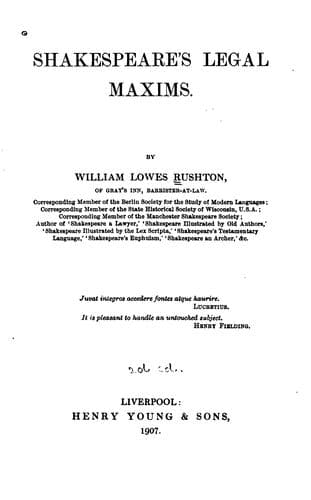
Law in literature; Shakespeare, William, 1564-1616 -- Knowledge -- Law
Executio est executio juris secundum judicium (3 Institute, 212). It is
a maxim of the law of England that the execution must be according to
the judgment, Et quæ in curia nostra rite acta sunt, debit’ executioni
demandari debent; and for express authority, Non licet felonem pro
felonia decollare. In the case of high treason, beheading is part of
the judgment, and therefore the king may pardon all the rest saving
beheading, as is usually done in case of nobility. But if a man being
attainted of felony be beheaded, it is no execution of the judgment,
because the judgment is, that he be hanged till he be dead: in this
case the judgment doth belong to the judge, and he cannot alter it; the
execution belongs to the sheriff, &c., and he cannot alter it. And if the
execution might be altered in this case from hanging to beheading, by the
same reason it might be altered to burning, stoning to death, &c. (3
Institute, 211). It is worthy of notice that Shakespeare seems to have
been well aware of the distinct offices of judge and executioner, for he
makes Guiderius, in speaking of Cloten, say—
Why should we be tender,
To let an arrogant piece of flesh threat us;
Play judge and executioner, all himself?
_Cymbeline_, Act iv. Scene 2.
If an officer beheads one who is adjudged to be hanged, or vice versâ, it
is murder (I. Hale P. C. 494; I. Hawk. P. C. c. xxviii. ss. 11, 12, 17,
18), for he is merely ministerial, and therefore only justified when he
acts under the authority and compulsion of the law; but if the sheriff
substitutes one kind of death for another, he then acts by his own
authority, which does not extend to the commission of homicide (4 Bla.
Com. 179). If the sheriff, or other proper officer, alters the execution
or any other doth execute the offender, or if he is slain without
authority of law, it is felony, and the law implies malice (Wood’s Inst.,
2nd ed., p. 662). So Clarence says to the murderers hired by Gloster—
_Clar._ Are you drawn forth among a world of men
To slay the innocent? What is my offence?
Where is the evidence that doth accuse me?
What lawful quest have given their verdict up
Unto the frowning judge? or who pronounc’d
The bitter sentence of poor Clarence’ death?
Before I be convict by course of law,
To threaten me with death is most unlawful.
_Richard III._, Act i. Scene 4.
Public-domain text, read in full here on John Shaqi.
Reviews
Reviews
No reviews yet
Be the first to share your thoughts on this work.
Join the Discussion
Join the discussion
Sign in to leave a comment or review.
Sign InorCreate an account