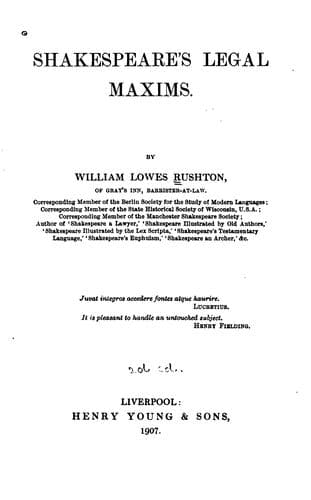
Law in literature; Shakespeare, William, 1564-1616 -- Knowledge -- Law
To conclude this point: Judicium est legibus, non exemplis (4 Rep. 33),
and Judicium est jurisdictum and Executio est executio juris secundum
judicium (3 Inst. 211). Buckingham may also refer to Gloster’s cruelty in
making the law an instrument of oppression or extortion and the liability
thereby incurred, for Executio juris non habet injuriam (2 Inst. 481; 1
Inst. 289a). The law in its executive capacity will not work a wrong.
If an individual, under colour of law, does an illegal act, or if he
abuses the process of the Court to make it an instrument of oppression
or extortion, this is a fraud upon the law, by the commission of which
liability will be incurred.
_Claud._ Fellow, why dost thou show me thus to the world?
Bear me to prison, where I am committed.
_Prov._ I do it not _in evil disposition_,
But from Lord Angelo by special charge.
_Measure for Measure_, Act i. Scene 3.
Qui jussu judicis aliquod fecerit non videtur dolo malo fecisse quia
parere necesse est (10 Rep. 70, 76).
Where a man does anything by command of a judge, the law will not
consider that he acted from any wrongful motive, because it was necessary
for him to comply with the orders of the judge. In 26 Ed. III. vii. 70,
it is taken for a maxim, that the thing which an officer doth by warrant
or command of a Court, cannot be said to be against the peace, and (Doct.
and Stud. 150) the king’s officers are bound to execute the king’s writs
at their peril (10 Rep. 70). When a Court has jurisdiction of a cause,
and proceeds inverso ordine or erroneously, no action lies against the
party who sues, or the officer or minister of the Court who executes the
precept or process of the Court. But when the Court has no jurisdiction
of the cause, then the whole proceeding is coram non judice, and actions
will lie against them without any regard of the precept or process, for
it is not necessary to obey him who is not a judge of the cause, no more
than it is to obey a mere stranger, for the rule is, Judicium a non suo
judice datum nullius est momenti (10 Rep. 76).
_Lady Macbeth._ What need we fear who knows it, when none can
call our power to account?
_Macbeth_, Act v. Scene 1.
_Lear._ No, they cannot touch me for coining; I am the king
himself.
_Goneril._ Say if I do; the laws are mine, not thine;
Who shall arraign me for it?
_Lear_, Act v. Scene 2.
Lady Macbeth, Lear, and Goneril seem to refer to the ancient and
fundamental principle of the English constitution, that the king can do
no wrong. Rex non potest peccare (2 Roll. R. 304; Jenk. Cent. 9, 308).
_Duke._ He dies for Claudio’s death.
Public-domain text, read in full here on John Shaqi.
Reviews
Reviews
No reviews yet
Be the first to share your thoughts on this work.
Join the Discussion
Join the discussion
Sign in to leave a comment or review.
Sign InorCreate an account