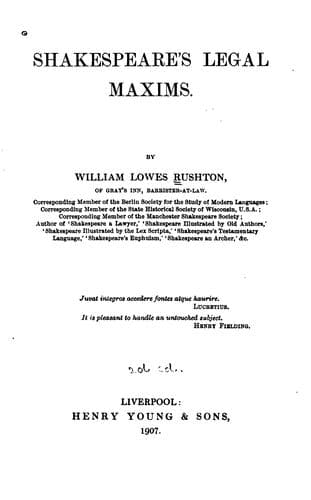
Law in literature; Shakespeare, William, 1564-1616 -- Knowledge -- Law
_Isab._ [_kneeling._] Most bounteous sir,
Look, if it please you, on this man condemn’d,
As if my brother liv’d. I partly think,
A due sincerity govern’d his deeds,
Till he did look on me: since it is so,
Let him not die. My brother had but justice,
In that he did the thing for which he died:
For Angelo,
His act did not o’ertake his bad intent;
And must be buried but as an intent
That perish’d by the way: thoughts are no subjects;
Intents but merely thoughts.
_Measure for Measure_, Act v. Scene 1.
An evil intention is not punishable equally with the fact; Crimen
non contrahitur nisi nocendi voluntas intercedit (Bracton, lib. cap.
4; Wood’s Inst., 2nd ed., p. 340), except in treason, when the maxim
Voluntas reputatur pro facto (3 Inst. 5, 69), the will is taken for the
deed, is said to apply to its full extent. It is a rule laid down by Lord
Mansfield, said to comprise all the principles of previous decisions in
similar cases (per Lawrence, J., Rex _v._ Higgins, 2 East, 21), that so
long as an act rests in bare intention, it is not punishable by the law
of England—so Ulpian says: ‘Cogitationis pœnam nemo patitur’ (D. 48, 19,
18), and Montesquieu: ‘Les lois ne se chargent de punir que les actions
exterieurs’—but when an act is done, the law judges not only of the act
itself, but of the intent with which it is done.
_Angelo._ What’s open made to justice,
That justice seizes.
_Measure for Measure_, Act ii. Scene 1.
And if the act be accompanied with an unlawful and malicious intent,
though in itself the act would otherwise be innocent, yet, the intent
being criminal, the act likewise becomes criminal and punishable (Rex
_v._ Scofield, 2 East, D. C. 1028). Non officit conatus, nisi sequitur
effectus (6 Rep. 42; Wood’s Inst., 2nd ed., p. 340), for it is a
principle of natural justice and of our law that the intent and the act
must both concur to constitute the crime (Lord Kenyon, 7, T. R. 514). But
where one has the use of his reason, and is at liberty, his endeavour to
commit a felony, as to rob, &c., is punishable, though not to that degree
as if the felony and robbery, &c., had actually been committed. For in
such cases Voluntas non reputabitur pro facto, the will shall not be
taken for the deed (3 Inst. 69; 11 Rep. 98).
_Ham._ Give me your pardon, sir: I’ve done you wrong;
But pardon’t, as you are a gentleman.
This presence knows, and you must needs have heard,
How I am punish’d with a sore distraction.
What I have done,
That might your nature, honour, and exception,
Roughly awake, I here proclaim was madness.
Was’t Hamlet wrong’d Laertes? Never Hamlet:
If Hamlet from himself be ta’en away,
And, when he’s not himself, does wrong Laertes,
Then Hamlet does it not; Hamlet denies it.
_Hamlet_, Act v. Scene 2.
Public-domain text, read in full here on John Shaqi.
Reviews
Reviews
No reviews yet
Be the first to share your thoughts on this work.
Join the Discussion
Join the discussion
Sign in to leave a comment or review.
Sign InorCreate an account