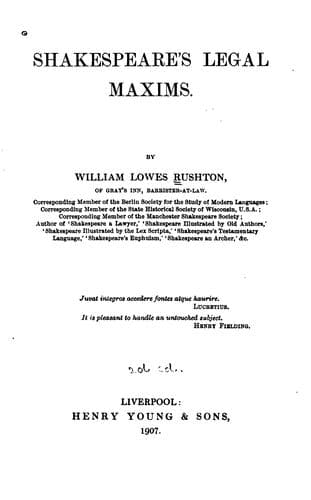
Law in literature; Shakespeare, William, 1564-1616 -- Knowledge -- Law
The tearing of Bolingbroke’s household coat was actionable, according to
the old maxim quoted by Coke, ‘Actio datur si quis arma, in aliquo loco
posita, delevit seu abrasit’ (3 Institute, 202). In _Pericles_, ii. 2,
Thaisa describes the devices on the shields of the six knights.
_Hor._ How was this seal’d?
_Ham._ Why, even in that was heaven ordinant.
I had my father’s signet in my purse,
Which was the model of that Danish seal;
Folded the writ up in form of the other,
Subscribed it, gave’t the impression, placed it safely,
The changeling never known.
_Hamlet_, Act v. Scene 2.
Sigillum est cera impressa, quia cera sine impressione non est sigillum
(Co. 3 Institute, 169).
The wax without an impression would not be a seal. Hamlet subscribed the
writ and also impressed the wax with his father’s signet. Crimen falsi
dicitur, cum quis illicitus, cui non fuerit ad hæc data auctoritas, de
sigillo regis rapto vel invento, brevia, cartasve consignaverit (Fleta).
_Lear._ No, they cannot touch me for coining; I am the king
himself.
_Lear_, Act iv. Scene 6.
Monetandi jus comprehenditur in regalibus quæ nunquam a regio sceptro
abdicantur (Dav. 18).
Shakespeare may here refer to this maxim, that the right of coining is
comprehended in those regal rights which are never removed from the regal
sceptre.
_Scici._ What is the city but the people?
_Cit._ True, the people are the city.
_Coriolanus_, Act iii. Scene 1.
In this passage Shakespeare probably refers to the maxim, Civitas et urbs
in hoc differunt quod incolæ dicuntur civitas, urbs vero complectitur
ædificia (Mirror, cap. 2, sect. 18, Brit. fol. 87, Co. Litt. 109b). A
city and a town differ in this, that the inhabitants are called the
city, but the town comprises the buildings.
_Duke._ We have strict statutes, and most biting laws,
(The needful bits and curbs to headstrong steeds,)
Which for these fourteen years we have let slip;
Even like an o’ergrown lion in a cave,
That goes not out to prey. Now, as fond fathers,
Having bound up the threatening twigs of birch,
Only to stick it in their children’s sight
For terror, not to use; in time the rod
Becomes more mock’d than fear’d; so our decrees,
Dead to infliction, to themselves are dead;
And liberty plucks justice by the nose;
The baby beats the nurse, and quite athwart
Goes of decorum.
_Measure for Measure_, Act i. Scene 3.
The wisdom of the law abhors that great offences should go unpunished,
which was grounded without question upon these ancient maxims of law and
state: Maleficia non debent remanere impunita, et impunitas continuum
affectum tribuit delinquendi, et minatur innocentes qui parcit nocentibus
(Co. Rep. iv. 45).
Public-domain text, read in full here on John Shaqi.
Reviews
Reviews
No reviews yet
Be the first to share your thoughts on this work.
Join the Discussion
Join the discussion
Sign in to leave a comment or review.
Sign InorCreate an account