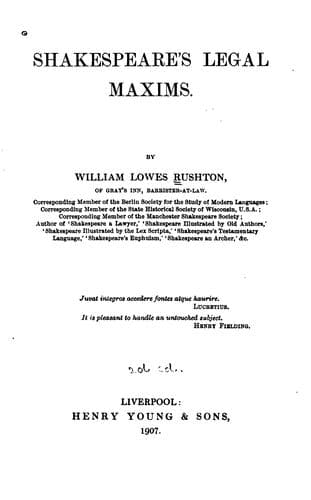
Law in literature; Shakespeare, William, 1564-1616 -- Knowledge -- Law
Crimes ought not to remain unpunished, and impunity offers a continual
temptation to the delinquent.
Spes impunitatis continuum affectum tribuit delinquendi (3 Institute,
236).
_Macb._ There’s blood upon thy face.
_Mur._ ’Tis Banquo’s, then.
_Macb._ ’Tis better thee without than he within.
Is he despatch’d?
_Mur._ My lord his throat is cut; that I did for him.
_Macb._ Thou art the best o’ the cut-throats:
Yet he’s good
That did the like for Fleance: if thou didst it,
Thou art the nonpareil.
_Mur._ Most royal sir,
Fleance is ’scaped.
_Macb._ Then comes my fit again: I had else been _perfect_,
Whole as the marble, founded as the rock,
As broad and general as the casing air.
_Macbeth_, Act iii. Scene 3.
Id perfectum est quod ex omnibus suis partibus constat; et nihil
perfectum est dum aliquid restat agendum (9 Co. 9).
Fleance had escaped, therefore Macbeth was not perfect, because something
remained to be done to make him—
Whole as the marble, founded as the rock.
_King._ Things done well,
And with a care, exempt themselves from fear;
Things done without example, in their issue
Are to be fear’d. Have you a precedent
Of this commission? I believe, not any.
We must not rend our subjects from our _laws_
And stick them in our _will_.
_Henry VIII._, Act i. Scene 2.
‘Neither have judges,’ says Coke, ‘power to judge according to that which
they think fit, but that which out of the laws they know to be right
and consonant to law.’ Judex bonus nihil ex arbitrio suo faciat, nec
proposito domesticæ voluntatis sed juxta leges et jura pronunciet (7 Co.
Rep.).
According to this maxim a good judge may do nothing from his free choice
or private _will_, but he must decide according to the _laws_, and King
Henry says—
We must not rend our subjects from our _laws_
And stick them in our _will_.
Angelo says—
Be you content, fair maid;
It is the law, not I, condemns your brother.
Were he my kinsman, brother or my son,
It should be thus with him; he must die to-morrow.
_Measure for Measure_, Act ii. Scene 2.
And according to another maxim of the law of England, Justitia non novit
patrem nec matrem, solam veritatem spectat justitia (I. Bulstrode, 199).
Justice knows not father nor mother, justice looks at the truth alone.
_Hector._ Brother, she is not worth what she doth cost
The holding.
_Troilus._ What is aught, but as ’tis valued?
Coke in his Third Institute, 105, considering how the value of a thing
shall be construed, quotes the maxim, Tantum bona valent quantum vendi
possunt; things are worth as much as they will sell for.
Public-domain text, read in full here on John Shaqi.
Reviews
Reviews
No reviews yet
Be the first to share your thoughts on this work.
Join the Discussion
Join the discussion
Sign in to leave a comment or review.
Sign InorCreate an account