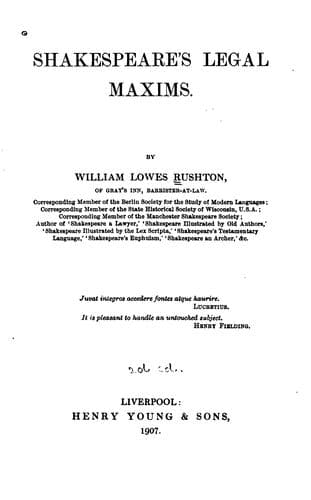
Law in literature; Shakespeare, William, 1564-1616 -- Knowledge -- Law
_Eli._ What now, my son! have I not ever said,
How that ambitious Constance would not cease,
Till she had kindled France, and all the world,
Upon the right and party of her son?
This might have been prevented, and made whole,
With very easy arguments of love;
Which now the manage of two kingdoms must
With fearful bloody issue arbitrate.
_K. John._ Our strong possession, and our right for us.
_Eli._ Your strong possession, much more than your right,
Or else it might go wrong with you and me:
So much my conscience whispers in your ear,
Which none but heaven, and you, and I, shall hear.
_King John_, Act i. Scene 1.
In æquali jure melior est conditio possidentis (Plowd. 296). Where the
right is equal, the claim of the party in possession shall prevail. The
lowest and most imperfect degree of title consists in the mere naked
possession, or actual occupation of the estate, without any apparent
right, or any shadow or pretence of right, to hold and continue such
possession. This may happen when one man invades the possession of
another, and by force or surprise turns him out of the occupation of his
lands; which is termed a desseisin, being a deprivation of that actual
seisin, or corporal freehold of the lands, which the tenant before
enjoyed (2 Bla. Com. 195; 1 Institute, 345). Or it may happen that after
the death of the ancestor and before the entry of the heir, or after the
death of the particular tenant and before the entry of him in remainder
or reversion, a stranger may contrive to get possession of the vacant
land, and hold out him that had a right to enter. In such cases the
wrong-doer has only a mere naked possession, which the rightful owner may
put an end to by a variety of legal remedies. But until some act be done
by the rightful owner to divest this possession and assert his title,
such actual possession is prima facie evidence of a legal title in the
possessor; and it may by length of time, and negligence of him who hath
the right, by degrees ripen into a perfect and indefeasible title (Bla.
Com. 196).
King John seems to refer to this maxim when he says—
Our strong possession and our right for us.
but Elinor says—
Your strong possession much more than your right,
because John was not in æquali jure with Arthur, but he was a wrong-doer,
having merely a naked possession; for after the death of Richard I., John
occupied the throne in defiance of the right of his nephew Arthur, who
was the son of John’s elder brother Geoffry.
_Hamlet._ Farewell, dear mother.
_King._ Thy loving father, Hamlet.
_Hamlet._ My mother: father and mother is man and wife;
Man and wife is one flesh; and so, my mother.
_Hamlet_, Act iv. Scene 3.
Vir et uxor sunt quasi unica persona, quia caro una, et sanguis unus.
(Bracton, lib. 5, Tract. 5, cap. 25).
Public-domain text, read in full here on John Shaqi.
Reviews
Reviews
No reviews yet
Be the first to share your thoughts on this work.
Join the Discussion
Join the discussion
Sign in to leave a comment or review.
Sign InorCreate an account