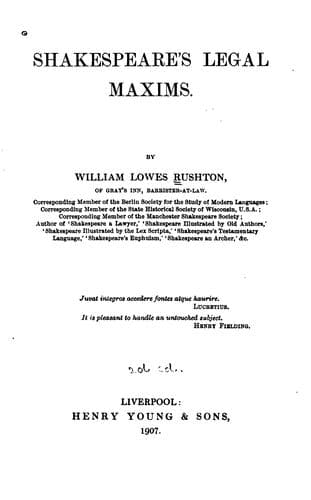
Law in literature; Shakespeare, William, 1564-1616 -- Knowledge -- Law
Man and wife are as one person, because they are one flesh and blood.
A man may not grant nor give his tenements to his wife, during the
coverture, for that his wife and he be but one person in law (Litt. S.
168).
If a joint estate be made of land to a husband and wife and to a third
person, in this case the husband and wife have in law in their right but
the moiety, and the third person shall have as much as the husband and
the wife, viz. the other moiety. And the cause is, for that the husband
and wife are but one person in law, and are in like case as if an estate
be made to two joint tenants, where the one hath by force of the jointure
the one moiety in law, and the other the other moiety (Litt. S. 221): for
the husband and wife are accounted to be one person in law, Duæ animæ in
carne una (Lex divina, and see 4 Rep. 118).
_Fal._ Of what quality was your love, then?
_Ford._ Like a fair house, built upon another man’s ground; so
that I have lost my edifice, by mistaking the place where I
erected it.
_Merry Wives of Windsor_, Act ii. Scene 2.
_Quick._ Marry, sir, I come to your worship from Mistress Ford.
_Fal._ Mistress Ford! I have had ford enough; I was thrown into
the ford; I have my belly full of ford.
_Quick._ Alas the day! good heart, that was not her fault: she
does so take on with her men; they mistook their erection.
_Fal._ So did I mine, to build upon a foolish woman’s promise.
_Merry Wives of Windsor_, Act iii. Scene 5.
Public-domain text, read in full here on John Shaqi.
Reviews
Reviews
No reviews yet
Be the first to share your thoughts on this work.
Join the Discussion
Join the discussion
Sign in to leave a comment or review.
Sign InorCreate an account