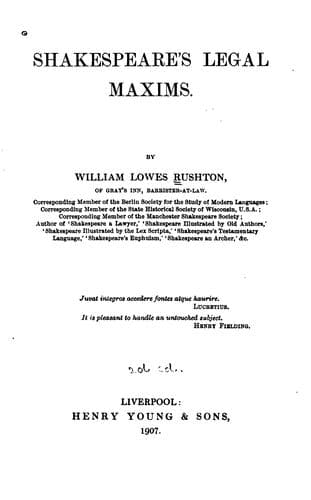
Law in literature; Shakespeare, William, 1564-1616 -- Knowledge -- Law
Quicquid plantatur solo solo cedit (Went. Off. Ex. 14 ed. 145). Whatever
is affixed to the soil belongs to the soil. It is a general and a very
ancient rule of law that whatever is affixed to the soil becomes, in
contemplation of law, a part of the soil, and is consequently subject to
the same rights of property as the soil itself. The ancient common law,
regarding land as of far more consequence than any chattel which could be
fixed to it, always considered everything attached to the land as part
of the land (4 Rep. 64a; Lord Raymond, 738; Mackintosh v. Trotter, 3 Mee
& Wel. 184, 186). Hence it follows that houses themselves, which consist
of an aggregate of chattels personal (namely, timber, bricks, &c.) fixed
to the land, were regarded as land and passed by a conveyance of the land
without express mention; and this is the law at the present time. So if
a man eject another from land and afterwards build upon it, the building
belongs to the owner of the ground on which it is built, according to
the principle Ædificatum solo solo cedit. But where a man, supposing
that he has a good title to an estate, builds upon the land with the
knowledge of the real owner, who allows the erections to be made, without
giving any notice of his claim, the Court of Chancery will compel him,
in a suit brought for the recovery of the land, to make due allowance
and compensation for such improvements. Ford evidently refers to this
maxim, and Falstaff probably intends this much to be understood, that he
committed as great a mistake, by building upon a foolish woman’s promise,
as they make who build upon another man’s ground. Shakespeare does not in
either of these passages, as Lord Campbell supposed, refer to Cujus est
solum ejus est usque ad cœlum, which expresses the extent of the rights
of the owner of land, but he refers to the maxim Ædificatum solo solo
cedit, which expresses the action of building on another man’s land and
the legal consequence of doing so.
When Shakespeare quotes a legal maxim he generally gives the words of
the maxim and the law which it describes. So Ford makes use of the verb
‘build’ and the noun ‘edifice’ which words are exact translations of
ædifico and ædificium.
George Chapman, in ‘May Day,’ makes a humorous application of Ædificium
cedit solo. Ædificatum solo solo cedit, and Quicquid plantatur solo solo
cedit, have their origin in Justinian’s Institutes.
_Angelo._ The law hath not been dead, though it hath slept.
_Measure for Measure_, Act ii. Scene 3.
Public-domain text, read in full here on John Shaqi.
Reviews
Reviews
No reviews yet
Be the first to share your thoughts on this work.
Join the Discussion
Join the discussion
Sign in to leave a comment or review.
Sign InorCreate an account