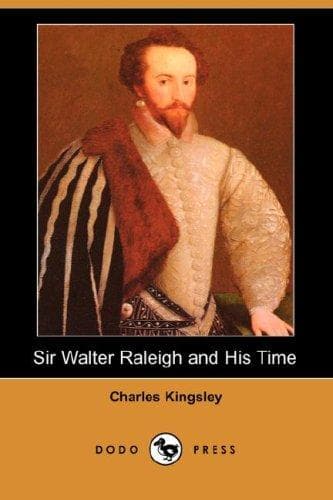
Great Britain -- History; Raleigh, Walter, Sir, 1552?-1618
with fury, he begins to intrigue with James, and slanders to him, under
colour of helping his succession, all whom he fancies opposed to him.
What is worse, he intrigues with Tyrone about bringing over an army of
Irish Papists to help him against the Queen, and this at the very time
that his sole claim to popularity rests on his being the leader of the
Puritans. A man must have been very far gone, either in baseness or in
hatred, who represents Raleigh to James as dangerous to the commonweal on
account of his great power in the west of England and Jersey, ‘places fit
for the Spaniard to land in.’ Cobham, as Warden of the Cinque Ports, is
included in his slander; and both he and Raleigh will hear of it again.
Some make much of a letter, supposed to be written about this time by
Raleigh to Cecil, bidding Cecil keep down Essex, even crush him, now that
he is once down. I do not happen to think the letter to be Raleigh’s.
His initials are subscribed to it; but not his name and the style is not
like his. But as for seeing ‘unforgiveness and revenge in it,’ whose
soever it may be, I hold and say there is not a word which can bear such
a construction. It is a dark letter: but about a dark matter and a dark
man. It is a worldly and expediential letter, appealing to low motives
in Cecil, though for a right end; such a letter, in short, as statesmen
are wont to write nowadays. If Raleigh wrote it, God punished him for
doing so speedily enough. He does not usually punish statesmen nowadays
for such letters; perhaps because He does not love them as well as
Raleigh. But as for the letter itself. Essex is called a ‘tyrant,’
because he had shown himself one. The Queen is to ‘hold Bothwell,’
because ‘while she hath him, he will even be the canker of her estate and
safety,’ and the writer has ‘seen the last of her good days and of ours
after his liberty.’ On which accounts, Cecil is not to be deterred from
doing what is right and necessary ‘by any fear of after-revenges’ and
‘conjectures from causes remote,’ as many a stronger instance—given—will
prove, but ‘look to the present,’ and so ‘do wisely.’ There is no real
cause for Cecil’s fear. If the man who has now lost a power which he
ought never to have had be now kept down, then neither he nor his son
will ever be able to harm the man who has kept him at his just level.
What ‘revenge, selfishness, and craft’ there can be in all this it is
difficult to see; as difficult as to see why Essex is to be talked of as
‘unfortunate,’ and the blame of his frightful end thrown on every one but
himself: the fact being that Essex’s end was brought on by his having
chosen one Sunday morning for breaking out into open rebellion, for the
purpose of seizing the city of London and the Queen’s person, and
compelling her to make him lord and master of the British Isles; in which
attempt he and his fought with the civil and military authorities, till
artillery had to be brought up and many lives were lost.
Public-domain text, read in full here on John Shaqi.
Reviews
Reviews
No reviews yet
Be the first to share your thoughts on this work.
Join the Discussion
Join the discussion
Sign in to leave a comment or review.
Sign InorCreate an account