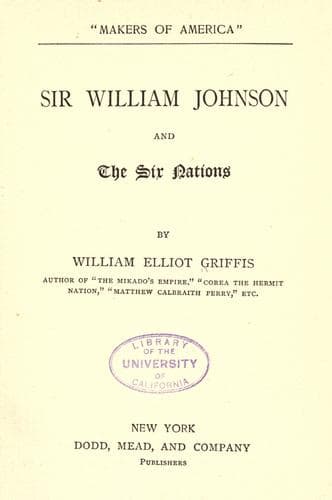
Sir William Johnson and the Six NationsGriffis, William Elliot
History
Sir William Johnson and the Six Nations
Griffis, William Elliot
Johnson, William, 1715-1774; United States -- History -- French and Indian War, 1754-1763
It was this spirit which explains the rude and rough treatment, by
Germans of both sexes, of arrogant royal agents and landlords in the
Schoharie Valley, and which at the erection of churches built by public
money, in which only a liturgical sect could worship, led to turbulence
and riot. Certain historic old edifices now standing were once finished
only after the king’s bayonets had been summoned to protect masons and
carpenters from people who hated the very sight of an established or
government church, built even partly by taxation, but shut to those of
the sects not officially patronized.
Among such a people, strong in the virtues of unspoiled manhood;
exhilarant with the atmosphere and splendid possibilities of the New
World; trained in the school of Luther’s Bible and the Heidelberg
Catechism; taught by Dutch laws commanding purchase of land from the
aborigines, and by the powerful example of Van Curler and their domines
or pastors, to be kind to the Indians,—Sir William Johnson, one of the
greatest of the makers of our America, came in 1738. It was the daughter
of one of the people of this heroic stock that he married. At a
susceptible age he learned their ideas and way of looking at things,
especially at their method of justly treating the Indians of the Six
Nations, who were looked upon as the rightful owners of the soil. Among
these people Johnson lived all his adult life. He was ever in kindly
sympathy with them, never sharing the supercilious contempt of those who
were and who are ignorant alike of their language, abilities, and
virtues.
-----
[1] See “The Leisler Troubles of 1689,” by Rev. A. G. Vermilye, D.D. New
York. 1891.
CHAPTER II.
JOHNSON AS AN INDIAN TRADER.
THERE is probably no good foundation for the local tradition, mentioned
by Gen. J. Watts De Peyster, in his Life of Gen. John Johnson (Preface,
p. ii, note), that the family name of William Johnson was originally
“Jansen, and that the first who bore it and settled in Ireland was a
Hollander, who, like many of his countrymen, went over afterward with
William III. in 1690, won lands and established themselves in Ireland.”
The subject is not mentioned in the Encyclopædia Britannica, and but
slightly treated in English works of reference, while he has been
unjustly slighted by American writers of history. According to his own
account, William Johnson was born in Smithtown, County Meath, near
Dublin, Ireland, in 1715.[2] His mother was Anne Warren, sister of the
brothers Oliver and Peter, who became famous officers in the British
Navy; and his father, Christopher Johnson, Esq. Writers and biographers
enlarge upon the ancient and honourable lineage of his mother’s family,
but say little about his father’s. To an American this matters less than
to those who must have a long line of known ancestry, real, reputed, or
manufactured.
Public-domain text, read in full here on John Shaqi.
Reviews
Reviews
No reviews yet
Be the first to share your thoughts on this work.
Join the Discussion
Join the discussion
Sign in to leave a comment or review.
Sign InorCreate an account