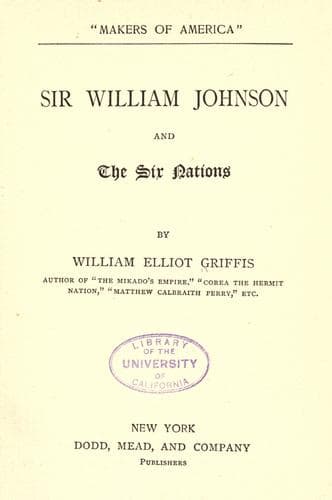
Sir William Johnson and the Six Nations — John Shaqi
Sir William Johnson and the Six NationsGriffis, William Elliot
History
Sir William Johnson and the Six Nations
Griffis, William Elliot
Johnson, William, 1715-1774; United States -- History -- French and Indian War, 1754-1763
After some schooling at a classical academy, William was trained to a
mercantile career. When about twenty-two years old, he fell in love with
a lass whom his parents refused to permit him to marry. This obstacle,
like a pebble that turns the course of the rivulet that is to become a
great river, shaped anew his life. The new channel for his energies was
soon discovered.
His uncle, Capt. Peter Warren, R. N., who had just returned from a
cruise, heard of his nephew’s unhappy experience, and made him the offer
of a position promising both wealth and adventure. Land speculation was
then rife; and Captain Warren, like many other naval officers, had
joined in the rush for lucre by buying land in the fertile Mohawk
Valley. This was in addition to land which was part of his wife’s dowry,
so that his estate was large, amounting, it is said, to fifteen thousand
acres. He appointed young Johnson his agent, to work his farm and sell
his building-lots. The young Irishman at once responded to the
proposition. He crossed the Atlantic, and promptly reported in New York.
Captain Warren, then about thirty years old, had married Susan, the
oldest daughter of Stephen De Lancey; and it was probably to the old
house, then thirty-eight years old, which still stands (in which
Washington took farewell of his generals in 1783), that the young
Irishman came. He was possessed of a fine figure, tall and strong, was
full of ambition and energy, with a jovial temper, and a power of quick
adaptation to his surroundings. In short, he was a typical specimen of
that race in which generous impulses are usually uppermost, and one of
the mighty army of Celtic immigrants who have helped to make of the
American people that composite which so puzzles the insular Englishman
to understand.
New York and Albany people were already getting rich by inland as well
as foreign trade, and the naval officer wished to invest what cash he
could spare from his salary or prize money in a mercantile venture, to
be begun at first on a modest scale in a frontier store. “Dear Billy,”
as his uncle addressed him in his letters, was not long in discovering
that the ambition of nearly every young man was to get rich, either in
the inland fur or West India trade, so as to own a manor, work it with
negro slaves, and join in the pomp and social splendour for which the
colony was already noted. It is more than probable that the ambition to
be rich and influential was strongly reinforced during his stay on
Manhattan Island.
The journey north, made according to the regular custom, was by sloop up
the Hudson, past the Palisades, the Highlands, the Catskills, and the
Flats, to Albany. After a few days in the only municipality north of New
York,—a log city with a few smart brick houses,—spent in laying in
supplies, the young immigrant would pass through the pine-barrens, and
after a day’s journey reach the State Street gate of palisaded
Schenectady.
Public-domain text, read in full here on John Shaqi.
Reviews
Reviews
No reviews yet
Be the first to share your thoughts on this work.
Join the Discussion
Join the discussion
Sign in to leave a comment or review.
Sign InorCreate an account