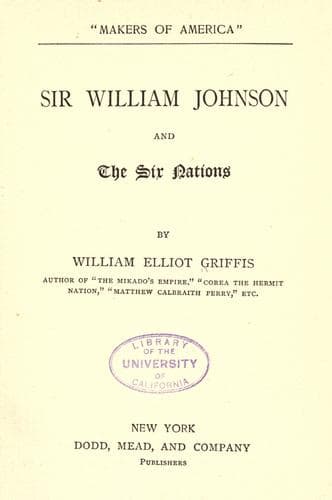
Sir William Johnson and the Six Nations — John Shaqi
Sir William Johnson and the Six NationsGriffis, William Elliot
History
Sir William Johnson and the Six Nations
Griffis, William Elliot
Johnson, William, 1715-1774; United States -- History -- French and Indian War, 1754-1763
State House, in which the Liberty Bell was to hang, and “proclaim
liberty to all the land, and to all the inhabitants thereof.” Going to
New York at his own expense, he, without fee, defended Zenger and
secured his acquittal. This event marks an important point in the making
of America and in the story of American freedom. It was in its effects
as significant as the skirmish at Lexington. The doctrine, novel at that
time in England but not in Holland, was advanced, that the truth of the
facts in the alleged libel could be set up as defence, and that in this
proceeding the jury were judges both of the law and the facts.
Though hundreds of Germans left New York for the greater advantage of
land and the liberty of Pennsylvania, which had been settled under
republican influences, yet those Palatines who rooted themselves in the
Schoharie and Mohawk Valleys proved one of the best stocks which have
made the American people. They were never popular with the men or women
who wanted to make America a new London or a new England, with courts
and castles, aristocracy and nobles, so called, entail and
primogeniture, the landlords of feudal domain, and other old-world
burdens. Honest, industrious, brave, God-fearing, truthful, and clean,
they soon dotted the virgin forest with clearings, farms, and churches.
Whatever else in their wanderings they lost or were robbed of, they
usually managed to hold to their hymn-books and Bibles, and, in the case
of the Reformed Churchmen, their Heidelberg Catechism. Their brethren in
Pennsylvania—the holy land of German-Americans—published the first
Bible in America, printed in a European tongue; and many early copies
found their way northward. They lived on terms of peace with the
Indians, treating these sons of the soil with kindness, and helping them
in generous measure to the benefits of Christianity. The most honest and
influential of Johnson’s Indian interpreters were of Dutch or German
stock.
Though other nationalities—Scottish, Irish, English—afterward helped
to make the Mohawk Valley at first polyglot, and then cosmopolitan, it
was by people of two of the strongest branches of the Teutonic race that
this fertile region was first settled. The dominant idea of these people
was freedom under law, reinforced by hearty contempt for the injustice
which masquerades under the forms of prerogative and of “majesty.” For
all the self-styled, insolent vicegerents of God, in both Church and
State, they felt a detestation, and were glad to find in America none of
these. If found, they felt bound to resist them unto the end. Theirs was
the democratic idea in Church and State, and they expressed it strongly.
Public-domain text, read in full here on John Shaqi.
Reviews
Reviews
No reviews yet
Be the first to share your thoughts on this work.
Join the Discussion
Join the discussion
Sign in to leave a comment or review.
Sign InorCreate an account