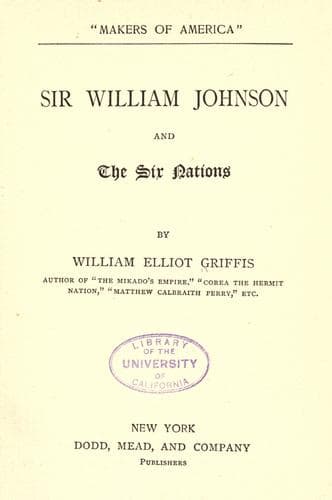
Sir William Johnson and the Six NationsGriffis, William Elliot
History
Sir William Johnson and the Six Nations
Griffis, William Elliot
Johnson, William, 1715-1774; United States -- History -- French and Indian War, 1754-1763
variously spelled than any other place in the United States; and its
name has been derived from Iroquois, German, and Japanese, in which
languages it is possible to locate the word as a compound. It is a
softened form of a long and very guttural Indian word.
Then was begun, by these Dutch freeholders, the long fight of fifty
years for freedom of trade with the Indians. Their contest was against
the restrictive jealousy of Albany, including both Colony and Manor.
With Dutch tenacity they held on, until victory at last crowned their
persistence in 1727.
In a word, in its initiation and completion, the opening of the Mohawk
Valley to civilization forms a noble episode in the story of American
freedom. One of the first places in New York on which the forces
representing feudalism and opposed to freeholding of land, and on which
mediæval European notions arrayed against the ideas which had made
America were beaten back, was at Schenectady, in the throat of the
Mohawk Valley. Here was struck by liberty-loving Hollanders a key-note,
of which the long strain has not yet ceased.
The immigrants who next followed the Dutch pioneers,—like them, as real
settlers, and not as land-speculators and manor-builders,—and who
penetrated still farther westward up the valley, were not English, but
German. These people, who, as unarmed peasants in the Rhine Valley, had
been unable to resist the invasion of Louis XIV. or to face the rigours
of poverty in their desolated homeland, made the best sort of colonists
in America. Brought by the British Government to settle on remote
frontiers, to bear the brunt of contact with Indians, Spaniards, and
Frenchmen, these sturdy Protestants soon proved their ability, not only
to stand their ground, but to be lively thorns in the sides of despotic
landlords, crown-agents, and governors.
The “first American rebel” Leisler, born at Mannheim in Germany, was a
people’s man. In his own rude way he acted with the intent of making
ideas dominant then, which are commonplace now. His “rebellion” grew out
of a boast made by the British Lieutenant-Governor Nicholson, that the
Dutch colonists were a conquered people, and not entitled to the right
of English citizenship. Hanged, by order of a drunken English governor,
near the site of the Tribune Building, May 16, 1691, it is more than
probable that he will yet have his statue in the metropolitan city of
America. He belongs to the list of haters of what is falsely named
aristocracy, the un-American state-church combination, and other relics
of feudalism which survive in England, but which had been cast off by
the Dutch Republic, in whose service as a soldier he had come to
America. His place in the list of the winners of American liberty is
sure.[1]
Public-domain text, read in full here on John Shaqi.
Reviews
Reviews
No reviews yet
Be the first to share your thoughts on this work.
Join the Discussion
Join the discussion
Sign in to leave a comment or review.
Sign InorCreate an account