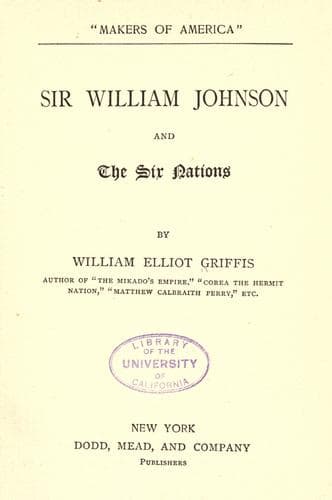
Sir William Johnson and the Six NationsGriffis, William Elliot
History
Sir William Johnson and the Six Nations
Griffis, William Elliot
Johnson, William, 1715-1774; United States -- History -- French and Indian War, 1754-1763
Under Governor Hunter’s auspices, in 1710, nearly three thousand Germans
from the Palatinate settled along the Hudson and in New York. By a third
immigration, in 1722, ten per cent was added to the population by the
Palatines, who settled all along the Mohawk Valley, advancing farther
westward into the “Woestina.” At German Flats and at Palatine Bridge
their “concentration” was greatest. So jealous were the money-loving
English of their wool-monopoly, that these Germans were forbidden under
extreme penalties to engage in the woollen manufacture. The same intense
jealousy and love of lucre which, until the Revolution, kept at home all
army contracts that could possibly be fulfilled in Great Britain,
prescribed the ban which was laid on the Mohawk Valley Palatines. With
chains thus forged upon the Germans, who were expected to furnish “naval
stores,” there was no encouragement for them to raise sheep or improved
stock. In this way it happened that Sir William Johnson was later
enabled to boast that he was the first who introduced fine sheep and
other live-stock in the Mohawk Valley.
The characteristics of these Germans were an intense love of liberty,
and a deep-seated hatred against feudalism and the encroachments of
monarchy in every form. The great land-owners, both Dutch and English,
who wished to use these people as serfs, found that they possessed
strange notions of liberty. Poor as they were, they were more like
hornets to sting than blue-bottles to be trapped with molasses. The
Hessian fly had a barb in his tail. Loyal to the Crown, they refused to
submit to the tyranny of the great landlords. It was one of these
Germans, a poor immigrant, that first fought and won the battle of the
freedom of speech and of the press. Now, intrenched in the Constitution
of the United States, it is to us almost like one of the numerous
“glittering generalities” of the Declaration of Independence, at which
Englishmen smile, but which Americans, including the emancipated
negroes, find so real. Then the freedom of the press was a dream. In
1734 John Peter Zenger, who incarnated the spirit and conscience of
these Palatine Germans, was editor of the “New York Weekly Journal.” He
was reproached as a foreigner and immigrant, for daring to criticise the
royal representatives, or ever to touch upon the prerogatives of
Governor Cosby, the king’s foolish representative. Zenger was
imprisoned, but managed to edit his paper while in jail. At his trial he
was defended by Hamilton, a lawyer from a colony whose constitution had
been written by the son of a Dutch mother, in Holland, where printing
had been free a century or more before it was even partially free in
England. James Alexander Hamilton was the Scottish lawyer who had left
his European home, to the detriment of his fortune, in order to enjoy
richer liberty in Pennsylvania. He it was who first purchased
Independence Square in Philadelphia, for the erection thereon of the
Public-domain text, read in full here on John Shaqi.
Reviews
Reviews
No reviews yet
Be the first to share your thoughts on this work.
Join the Discussion
Join the discussion
Sign in to leave a comment or review.
Sign InorCreate an account