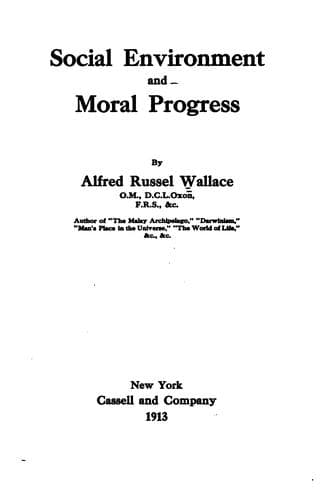
Social Environment and Moral ProgressWallace, Alfred Russel
Philosophy
Social Environment and Moral Progress
Wallace, Alfred Russel
Natural selection; Social ethics
been derived by means of the fundamental facts of variability and
reproduction from some allied plant or animal.
It is interesting here to note, that the two _essential factors_ of the
process of constant adaptation to the environment by great variability
and rapid multiplication, formed no part of Lamarck's theory, which
some people still think to be as good as Darwin's. Equally suggestive
is the fact that, while extensive groups of life-phenomena, such as
colour, weapons, hair, scales, and feathers, can hardly be conceived as
having been produced or modified by _effort_ or by the direct action of
the environment, they are yet, every one of them, perfectly explained
by the fundamental and necessary processes of variability and survival,
acting slowly and continuously, but with intermittent periods of
extreme activity at long intervals, on all living things.
One of the weakest and most foolish of all the objections to the
Darwinian theory is, that it does not explain _variation_, and is
therefore worthless. We might as well say that Newton's discovery of
the laws of gravitation was worthless because its _cause_ was not and
has not yet been discovered; or that the undulatory theory of light
and heat is worthless, because the origin of the ether, the thing
that _undulates_, is not known. The _beginnings_ of things can never
be known; and, as Darwin well said, it is foolish to waste time in
speculation about them. I think I have shown in my _World of Life_
that infinite variability is a basic law of Nature, and have suggested
its probable purpose. That purpose seems to have been the development
of a life-world culminating in Man—a being capable of studying, and
enjoying, and to some extent comprehending, the vast universe around
him, from the microscopic life in almost every drop of water to the
whirling nebulæ of the glittering star-depths extending to almost
unimaginable distances around him.
Looking at him thus, man is as much above, and as different from, the
beasts that perish as they are above and beyond the inanimate masses of
meteoritic matter which, as we now know, occupy the apparently vacant
spaces of our solar system, and from which comets and stars are in all
probability the aggregations due to the action of the various cosmic
forces which everywhere seem capable of producing variety and order out
of a more uniform but less orderly chaos.
Public-domain text, read in full here on John Shaqi.
Reviews
Reviews
No reviews yet
Be the first to share your thoughts on this work.
Join the Discussion
Join the discussion
Sign in to leave a comment or review.
Sign InorCreate an account