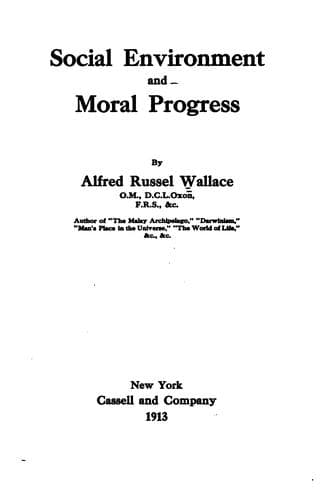
Social Environment and Moral Progress — John Shaqi
Social Environment and Moral ProgressWallace, Alfred Russel
Philosophy
Social Environment and Moral Progress
Wallace, Alfred Russel
Natural selection; Social ethics
Accompanying this fine literature and moral teaching in Ancient
India was a civilisation equal to that of early classical races, in
grand temples, forts and palaces, weapons and implements, jewelry
and exquisite fabrics. Their architecture was highly decorative and
peculiar, and has continued to quite recent times. Owing perhaps to the
tropical or sub-tropical climate, with marked wet and dry seasons, the
oldest buildings that have survived, even as ruins, are less ancient
than those of Greece or Rome—but those corresponding in age to the
period of our Gothic cathedrals are immensely numerous, and show an
originality of design, a wealth of ornament, and a perfection of
workmanship equal to those of any other buildings in the world.
Two other great civilisations of which we have authentic records are
those of Egypt and Mesopotamia, both of which appear to have been
much older than those of India or Greece. But whereas Egypt has left
us the most continuous series of tombs, temples, and palaces in the
world, abundant works of art in statues and sculptures, together with
characteristic reliefs and wall paintings, showing the whole public
and domestic life of the people, Mesopotamia is represented only by
vast masses of ruins on the sites of the ancient cities of Nineveh
and Babylon, from which have been disinterred many fine statues and
reliefs, exhibiting a very distinct style of art. For more than 2,000
years the history and remains of this once greatest of civilisations
was absolutely unknown, except by a few doubtful facts and names in
Greek and Hebrew writings. But during the latter half of the nineteenth
century a band of explorers and students, such as Layard and Rawlinson,
made known, first the works of art, and, latterly, an enormous quantity
of small bricks and stone slabs, thickly covered with a peculiar
kind of writing known as the cuneiform inscriptions, which, after
an enormous amount of labour, have at length been translated. Whole
libraries of these brick-books have been discovered, and as the reading
and translating goes on, we obtain a knowledge of the history, laws,
customs, and daily life of this ancient people almost equal to that we
now possess of the ancient Indians and Egyptians.
For our present purpose, however, Egyptian civilisation is the most
important, because it presents us with the most definite proof of the
attainment of a high degree of what is specially scientific attainment
at the very dawn of historical knowledge. This is well exhibited by
that most wonderful work of constructive art—the Great Pyramid of
Gizeh—which, though not quite the earliest, is the largest and most
remarkable of about seventy pyramids in various parts of Egypt, and has
been more thoroughly explored and studied, both as to its proportions,
construction and uses, than any of the others.
Public-domain text, read in full here on John Shaqi.
Reviews
Reviews
No reviews yet
Be the first to share your thoughts on this work.
Join the Discussion
Join the discussion
Sign in to leave a comment or review.
Sign InorCreate an account