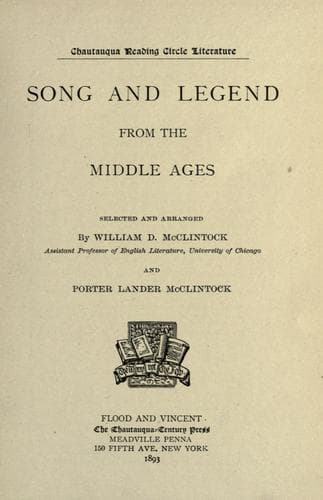
Literature, Medieval -- History and criticism; Literature, Medieval -- Translations into English
--Charles d'Orleans. Tr. by Longfellow.
THE BALLADE OF DEAD LADIES.
Tell me now in what hidden way is
Lady Flora the lovely Roman?
Where's Hipparchia, and where is Thais,
Neither of them the fairer woman?
Where is Echo, beheld of no man,
Only heard on river and mere,--
She whose beauty was more than human? ....
But where are the snows of yester-year?
Where's Heloise, the learned nun,
For whose sake Abeillard, I ween,
Lost manhood and put priesthood on?
(From love he won such dule and teen!)
And where, I pray you, is the Queen
Who willed that Buridan should steer
Sewed in a sack's mouth down the Seine? ....
But where are the snows of yester-year?
White Queen Blanche, like a queen of lilies,
With a voice like any mermaiden,--
Bertha Broadfoot, Beatrice, Alice,
And Ermengarde the lady of Maine,--
And that good Joan whom Englishmen
At Rouen doomed and burned her there,--
Mother of God, where are they then? ....
But where are the snows of yester-year?
Nay, never ask this week, fair lord,
Where they are gone, nor yet this year,
Save with thus much for an overword,--
But where are the snows of yester-year?
--Villon. Tr. by D. G. Rossetti.
LYRIC POETRY--PROVENCAL.
Modern scholars separate the treatment of Provencal literature
from that of French. It was written in a different dialect, was
subject to somewhat different laws of development, and after a
short period of activity died almost completely away.
Provencal literature is that produced in ancient Provence or
Southern France. Its period of life extended from the eleventh to
the fifteenth centuries, its middle and only important period
being that of the twelfth and thirteenth centuries. This
literature contains examples of all the varieties of French
literature of the Middle Ages, but the only work that is original
and important is its lyric poetry. This was composed by the
troubadours (corresponding to the French trouveres) and sung by
jongleurs or minstrels. The names of 460 Provencal poets and 251
anonymous pieces have come down to us. The one great theme of
troubadour-singing--one, too, upon which he was original and a
master--was that of passionate love. With this as subject, these
poets united an eagerness for form, and were the first to perfect
verse in any modern language.
PIERRE ROGIERS. Twelfth Century.
Who has not looked upon her brow
Has never dreamed of perfect bliss,
But once to see her is to know
What beauty, what perfection, is.
Her charms are of the growth of heaven,
She decks the night with hues of day:
Blest are the eyes to which 't is given
On her to gaze the soul away!
--Tr. by Costello.
GUILLEM DE CABESTANH. Twelfth Century.
Public-domain text, read in full here on John Shaqi.
Reviews
Reviews
No reviews yet
Be the first to share your thoughts on this work.
Join the Discussion
Join the discussion
Sign in to leave a comment or review.
Sign InorCreate an account