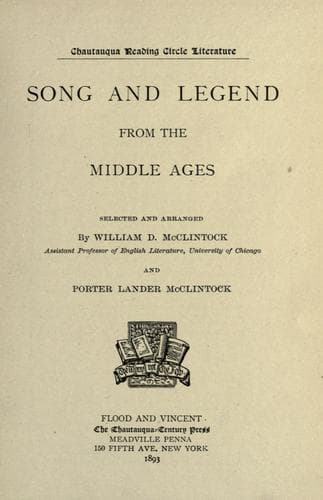
Literature, Medieval -- History and criticism; Literature, Medieval -- Translations into English
The period, then, of the eleventh, twelfth, and thirteenth
centuries was one of intense political life, of advanced national
self-consciousness, of rich, highly-organized society. It was
moreover a period of common ideas, movements, and tendencies over
all Europe. Several factors enter into this result:
1. The church was completely organized, forming a common life and
teaching everywhere. She had learned to employ the savage vigor
and conquering instincts of the northern barbarians as defenses
and aggressive missions of her spirit and ideas. The monasteries
were homes of learning, and from them issued the didactic
literature and the early drama.
2. This resulted in that romantic institution or ideal of
chivalry, whose ten commandments explain so much of mediaeval
life and art.[1]
[1] "Chivalry", by Leon Gautier, 1891, p. 26.
(1) Thou shalt believe all the church teaches, and shalt observe
all its directions.
(2) Thou shalt defend the church.
(3) Thou shalt respect all weaknesses, and shalt constitute
thyself the defender of them.
(4) Thou shalt love the country in which thou wast born.
(5) Thou shalt not recoil before thine enemy.
(6) Thou shalt make war against the inflael without cessation and
without mercy.
(7) Thou shalt perform scrupulously thy feudal duties, if they be
not contrary to the law of God.
(8) Thou shalt never lie, and shalt remain faithful to thy
pledged word.
(9) Thou shalt be generous and give largesse to every one.
(10) Thou shalt be everywhere and always the champion of the
Right and the Good against Injustice and Evil.
3. This combination of the Christian and the warrior found its
public activity most completely in the Crusades. They gave a
common motive and ideal to all the knights of Europe. They
brought them together for thinking and for fighting. They spread
national traditions and literatures. They made the whole face of
Europe and the borders of the Mediterranean known to the
ambitious, venturesome, daring, and heroic of every European
country. The exploits of chivalric knights were told from camp to
camp and taken back home to be told again in the castles.
4. Another institution of feudalism that helped to make this
common subject and spirit of mediaeval literature was the
minstrel, who was attached to every well-appointed castle. This
picturesque poet--gleeman, trouvere or troubadour sang heroic
stories and romances of love in the halls of castles and in the
market places of towns. He borrowed from and copied others and
helped to make the common method and traditions of mediaeval
song.
5. Other elements in this result were the extensions of commerce
and the growth of traveling as a pleasure.
6. Finally, the itinerant students and teachers of mediaeval
universities assisted in the making of this common fund of ideas
and material for literature.
Public-domain text, read in full here on John Shaqi.
Reviews
Reviews
No reviews yet
Be the first to share your thoughts on this work.
Join the Discussion
Join the discussion
Sign in to leave a comment or review.
Sign InorCreate an account