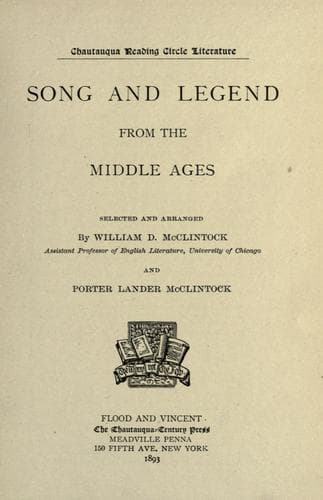
Literature, Medieval -- History and criticism; Literature, Medieval -- Translations into English
(7) Behind and within all the separate national literatures lay
the common Christian-Latin literature of the early Middle Ages,
undoubtedly the cause of the rather startling perfection of form
shown by much of the work of the period we are studying.[1]
[1] See Ebert "Allgemeine Geschichte der Literatur des
Mittelalters". Vol. I., p. 11.
The result of all these unifying tendencies is to give a strong
family likeness to the productions of the various European
countries of the eleventh, twelfth, and thirteenth centuries. The
subject matter often varies, but the motive and form of writing
are much alike. This likeness can be seen by a short survey of
the more important kinds of literature of the period.
I. THE NATIONAL EPIC.
In every country in which the national epic grew up it had the
same origin and line of development. First there was the
historical hero. His deeds were related by the traveling gleeman
or minstrel--in brief chapters or ballads. Gradually mythical and
supernatural elements came in; the number of achievements and the
number of ballads grew very large; in this oral state they
continued for many years, sometimes for centuries.
Finally, they were collected, edited, and written down--generally
by a single editor. In all cases the names of the poets of the
ballads are lost; in most cases the names of their redactors are
but conjectural. "The Song of Roland", and the "Poem of the Cid"
are typical, simple, national epics. The "Niebelungen Lied" is
complicated by the fact that the legends of many heroes are fused
into one poem, by the fact that it had more than one editor, and
by the survival of mythological elements which mingle confusedly
with Christian features. The national epic is the expression of
the active side of chivalry. Italy has no national epic, both
because she was too learned to develop a folk-poetry, and because
the ideas of chivalry were never very active in her history.
II. ROMANCES.
The numberless romances that sprang up in the literary period of
the Middle Ages may be thrown into three groups:
1. Those belonging to the legend of Arthur and the Round Table.
They had their starting point in the history of Geoffrey of
Monmouth, which was partly invented, but had some basis in a
tradition common to the Bretons and the Welsh. The romances based
upon this legend sprang up apparently simultaneously in England
and France. Through minstrel romances, founded upon the Breton
popular tradition, the Arthur legend probably first found its way
into European literature. With it was early fused the stories of
the Holy Grail and of Parzival. In the twelfth century these
stories were widely popular in literary form in France and
Germany, and later they passed into Italy, Spain, and
Scandinavia. Their influence upon the life and thought of
Mediaeval Europe is very important. They did much to modify the
entire institution of chivalry.[1]
[1] Leon Gautier's "Chivalry", chap. IV., Section V.
Public-domain text, read in full here on John Shaqi.
Reviews
Reviews
No reviews yet
Be the first to share your thoughts on this work.
Join the Discussion
Join the discussion
Sign in to leave a comment or review.
Sign InorCreate an account