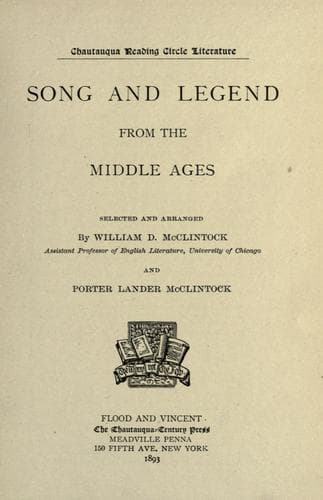
Literature, Medieval -- History and criticism; Literature, Medieval -- Translations into English
2. The Romances of Antiquity, of which there are three varieties:
(1) Those which were believed to be direct reproductions, such as
the Romances of Thebes, of Aeneas, of Troy, whose authors
acknowledged a debt to Vergil, Statius, and other classic
writers.
(2) Those based upon ancient history not previously versified,
such as the Romance of Alexander.
(3) Those which reproduced the names and nothing else from
antiquity.
These romances, too, were a common European possession. The most
important and influential of them are the Romance of Troy, and
the Romance of Alexander. They appear in different forms in the
literature of every mediaeval nation in Europe.
3. There was in each national literature a vast number of
unaffiliated romances. A romance of this group usually contained
a love story, a tale of adventure, or a religious experience in
the form of a story. They are not clearly distinct from the class
of popular tales. On the whole, the romance is more serious and
dignified than the tale. Examples of this kind of a romance are
Hartmann von Aue's "Henry the Leper", and the French "Flore et
Blanchefleur".
III. LYRICS.
Perhaps no other part of its literature shows more striking proof
of the common life and interests of Mediaeval Europe than does
the lyric poetry of the period. In Northern France, in Provence,
in all parts of Germany, in Italy, and a little later in Spain,
we see a most remarkable outburst of song. The subjects were the
same in all the countries. Love-the love of feudal
chivalry--patriotism, and religion were the themes that employed
the mediaeval lyrist in whatever country he sang. In all these
lyrics much was made of form, the verse being always skillfully
constructed, sometimes very complicated. The lyric poetry of
Italy was more learned and more finished in style than that of
the other countries.
In Northern France the poet was called a trouvere, in Provence a
troubadour, in Germany a minnesinger. The traveling minstrel was
in France a jongleur (Provencal jogleur). The distinction between
trouvere or troubadour and jongleur is not always to be sharply
drawn. Sometimes in France and Provence the same poet composed
his verses and sang them--was both trouvere or troubadour and
jongleur; while in Germany the minnesingers were generally both
poets and minstrels.
IV. TALES AND FABLES.
No distinct line can be drawn between Tales and Fables; between
Romances and Tales; nor between Fables and Allegories. These
varieties of writings merge into one another.
Public-domain text, read in full here on John Shaqi.
Reviews
Reviews
No reviews yet
Be the first to share your thoughts on this work.
Join the Discussion
Join the discussion
Sign in to leave a comment or review.
Sign InorCreate an account