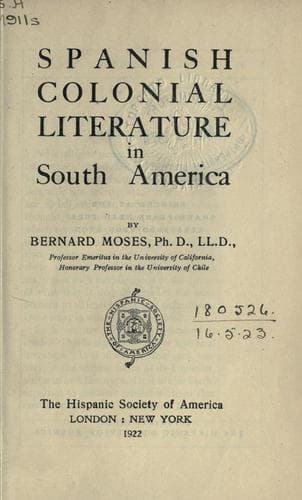
Spanish colonial literature in South AmericaMoses, Bernard
History
Spanish colonial literature in South America
Moses, Bernard
Spanish American literature -- History and criticism
The inconvenience of sending manuscripts to Spain to be examined and
approved or disapproved by the Council of the Indies is illustrated by
Bishop Villarroel’s experience. He sent the manuscript of _El gobierno
eclesiástico pacífico_ to Spain, but the vessel carrying it was wrecked,
and only by great good fortune was the manuscript saved. He sent another
work in four volumes to Madrid, and solicited permission to publish
it. The issuing of the licence was delayed three years, and in the
meantime the manuscript was lost. The legal obstacles and the practical
difficulties in the way of obtaining permission to print help to explain
why many manuscripts, written in America or about America, remained
unpublished until after the overthrow of Spanish rule in the Indies. Even
after the establishment of presses in America, the great cost of paper
furnished an obstacle to their extensive use, and except in Mexico and
Lima there were few printing presses until late in the colonial period.
While the Inquisition tended to destroy free intellectual activity in
the Spanish colonies, the Church in other ways contributed to a certain
cultivation along lines approved by itself. It helped to preserve
old-world traditions in some departments of life. By the study of
the Indian languages, which it encouraged, and the formation and the
publication of grammars, it made public and preserved a knowledge of
these languages. It, moreover, founded and supported schools, that
maintained the light of learning, though a feeble and fluctuating light,
within a narrow ecclesiastical horizon. But all efforts in favour of
liberal enlightenment were counteracted by governmental measures in
opposition to the importation of books, particularly secular books of all
kinds.
[Sidenote: The range of learning]
But the range of learning was limited. Until near the end of the colonial
period instruction in the colleges and universities retained its mediæval
character. The curriculum of studies embraced little, if anything,
besides Latin, philosophy, and theology. Having attained proficiency in
Latin the student was admitted to the courses on philosophy under the
faculty of arts. After three years with this faculty he passed to the
study of theology, which was continued for four, and later for five,
years. The first enlargement of this curriculum was effected by the
addition of jurisprudence, or Roman law. This change was not made until
near the end of the eighteenth century.[7]
[Sidenote: Teaching by Jesuits]
Public-domain text, read in full here on John Shaqi.
Reviews
Reviews
No reviews yet
Be the first to share your thoughts on this work.
Join the Discussion
Join the discussion
Sign in to leave a comment or review.
Sign InorCreate an account