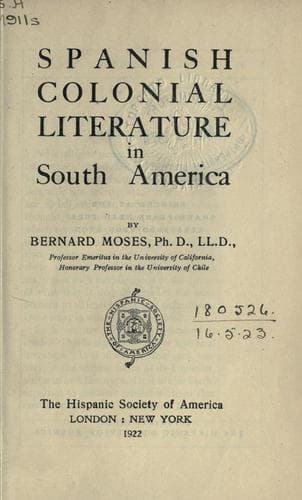
Spanish colonial literature in South America — John Shaqi
Spanish colonial literature in South AmericaMoses, Bernard
History
Spanish colonial literature in South America
Moses, Bernard
Spanish American literature -- History and criticism
The expulsion of the Jesuits in 1767 was a very severe blow to scholarly
and literary activity in colonial society. The Jesuits had a school
or a college in every important town of the dependencies, and their
instruction was clearer and more effective than that of the other
schools, although one is sometimes disposed to regard their employment
of a rigid mould of predetermined form, in which to cast all minds, as
the greatest educational error of history. But under conditions where,
outside of the chief towns, the dominating influences made either for the
roughness of the camp or the brutishness of semi-barbarism, a system of
instruction that trained the mind to a definite standard was not without
its merits, although that standard was the inelastic standard of the
Jesuits.[8]
[Sidenote: The viceregal academy]
[Sidenote: _Triunfos de amor y poder_]
The universities presumed a more or less extensive group of cultivated
persons in the towns where they were established; and when these towns
were also the principal seats of government, as were Lima, Bogotá,
Santiago de Chile, and Caracas, the officials of the administration
formed another superior element in the population. Lima, as the viceroy’s
residence, was the social capital of the dependencies. The powers of
the viceroy were practically those of an autocratic ruler, during the
period of his incumbency, and there were brought to Lima from Spain many
of the forms and ceremonies of the Spanish court. The viceroy appeared
in public with much of the state affected by European monarchs of the
seventeenth and eighteenth centuries. Sometimes he used the influence
of his high position to encourage learning and literary activity.
The viceregal palace, in the reign of the viceroy Casteldosríus, was
the meeting-place of a society where authors assembled every Monday
to present their writings and discuss subjects of interest to men of
letters. Dr. Pedro Peralta Barnuevo, the author of _Lima fundada_, was
a member of this academy. But the “high society” of Lima had a lower
conception of literature and literary men than the learned viceroy, and
expressed regret that the ancient customs and dignity of the viceregal
office had been violated by the participation of the head of the state in
the proceedings of a literary society. The victory of the French under
Vendome over the Austrians under Starhemberg was celebrated at the palace
by the production of Barnuevo’s comedy called _Triunfos de amor y poder_;
and there were more regrets by the aristocracy that the palace of the
viceroy had been turned into a theatre.
[Illustration: El Marqués de Casteldosríus, 24th Viceroy of Peru
1707-1710]
[Sidenote: Lima and the other capitals]
Public-domain text, read in full here on John Shaqi.
Reviews
Reviews
No reviews yet
Be the first to share your thoughts on this work.
Join the Discussion
Join the discussion
Sign in to leave a comment or review.
Sign InorCreate an account