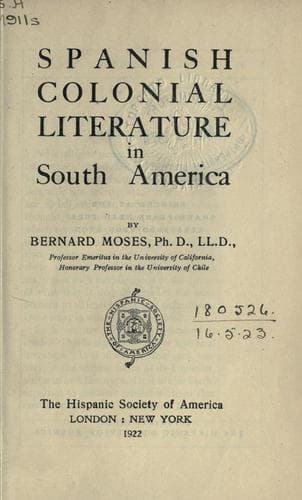
Spanish colonial literature in South AmericaMoses, Bernard
History
Spanish colonial literature in South America
Moses, Bernard
Spanish American literature -- History and criticism
It was beings answering to this ideal that fascinated Las Casas, and a
large part of the civilized world has been disposed to honour him for his
marvellous service in the interest of an oppressed and outraged people;
but when his eulogists announce him as the champion of universal human
liberty, they make too large a claim. A champion of the liberty of the
Indians he surely was, a champion of rare devotion and unflagging zeal,
but with little concern as to the social cost of securing that liberty by
his method. He was, moreover, so thoroughly absorbed in his own ideas and
plans that he had no mind to consider the ideas and plans of others, or
to deliberate with other persons in an attitude of possible compromise.
He did not hesitate to seek with unslacking energy the execution of his
plan, even when he was aware that it involved extending negro slavery,
with all the horrors of the transoceanic shipment of slaves.
[Sidenote: Encomenderos and liberty]
Las Casas’ project to introduce Spaniards into America to undertake the
common work which the Indians were required to perform, or to throw
the burden upon negroes, necessarily ran counter to the views of those
Spaniards to whom Indians had been assigned by the government in Spain,
and who depended upon the labour of the Indians to cultivate the lands
that had been granted to them, to work their mines, and to carry on
their manufacturing enterprises. The encomenderos had come to regard
themselves as the foundation of the economic system of the colonies,
and they naturally considered the government under obligation to defend
them against attacks designed to destroy that system. But Las Casas
had enthusiastic partisans, who praised extravagantly his devotion to
the Indian and were apparently blind to the consequences of extending
negro slavery with respect to the development of society in America.
The intense hostility displayed towards Las Casas in the colonies did
not proceed solely from his proposed interference with the interests of
the encomenderos, but was in a large measure provoked by his reckless
denunciation of opponents.
[Sidenote: Reception of Las Casas’ views]
The views set forth in _Brevísima relación de la destrucción de las
Indias_ found an enthusiastic reception, particularly in England,
promoted by the political friction existing between that country and
Spain, and by the rage of militant Protestantism, which found in Las
Casas’ denunciation at least a partial expression of its own detestation
of Catholicism and of all measures favoured by the Pope. The titles given
to translations of the _Brevísima relación_ are evidence of the force of
that sentiment.[10]
[Sidenote: Vargas Machuca]
[Sidenote: Opponents of Las Casas]
Public-domain text, read in full here on John Shaqi.
Reviews
Reviews
No reviews yet
Be the first to share your thoughts on this work.
Join the Discussion
Join the discussion
Sign in to leave a comment or review.
Sign InorCreate an account