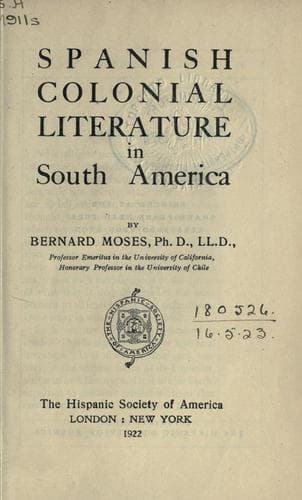
Spanish colonial literature in South AmericaMoses, Bernard
History
Spanish colonial literature in South America
Moses, Bernard
Spanish American literature -- History and criticism
This pamphlet was published in 1552, and aroused in the minds of some of
the Spaniards an opposition only a little less marked than the favour
with which it was received by the English. Bernardo de Vargas Machuca
was one of those who rose to combat the views presented by Las Casas.
His refutation appeared in _Apologías y discursos de las conquistas
occidentales_. On the title-page of this pamphlet the author announces
that it is written “in opposition to the treatise on the ruin of the
Indies.”[11] The question concerning the servitude or the freedom of
the Indians raised by Las Casas was discussed by a professor in the
University of Córdoba, who wrote _Fasti novi orbis_ under the name of
Cyriacus Morelli. His book was published in Venice in 1776. Dr. Juan
Ginés de Sepúlveda, a distinguished Spanish theologian and jurist,
opposed vigorously the ideas presented by Las Casas, and argued in
support of the Spanish policy regarding the Indians. A similar attitude
was assumed by Gonzalo Fernández de Oviedo, whose education at the
Spanish court, and whose later service under appointment by the king
naturally disposed him to justify the conduct of the government. This
subject continued to engage the attention of writers as long as the
Spanish régime lasted. A work by Giovanni Nuix translated from the
Italian by Pedro Varela y Ulloa, entitled in Spanish _Reflexiones
imparciales sobre la humanidad de los españoles en las Indias, contra
los pretendidos filósofos y políticos_, was published in Madrid in 1782.
The writer characterized the views of Las Casas as false or exaggerated,
and defended the thesis that the conquests made by the Spaniards in
America were just, or at least as just as those made by other nations;
and he attributed whatever covetousness or cruelty was displayed by
the Spaniards to the great distance of the colonies from the supreme
authority, under which local officers served in the colonies without
adequate supervision. He distinguished clearly, moreover, between
the benevolent designs of the crown and the unjust and cruel acts of
governmental subordinates and irresponsible private persons.
[Sidenote: Las Casas’ _Historia general_]
[Sidenote: _Historia apologética_]
[Sidenote: Conversion of Indians]
Public-domain text, read in full here on John Shaqi.
Reviews
Reviews
No reviews yet
Be the first to share your thoughts on this work.
Join the Discussion
Join the discussion
Sign in to leave a comment or review.
Sign InorCreate an account