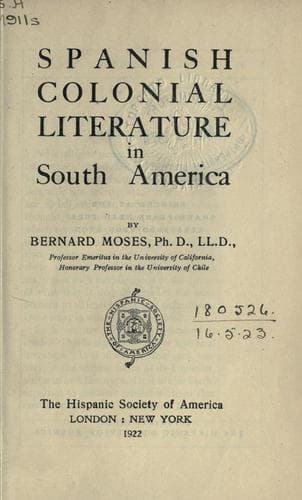
Spanish colonial literature in South AmericaMoses, Bernard
History
Spanish colonial literature in South America
Moses, Bernard
Spanish American literature -- History and criticism
Besides the _Brevísima relación_ a number of other pamphlets were
printed in 1552 and 1553, but the more important of Las Casas’ writings
remained in manuscript until long after the author’s death. These are
the _Historia general de las Indias_ and _Historia apologética de las
Indias_, apparently designed in the beginning to constitute a single
work; but in the process of their composition, the character of each
became more and more distinct, and they finally appeared in print as
separate productions. The former is an account of the occupation of
the West Indies and the mainland during the early years of Spanish
rule, describing the condition of the native inhabitants, their mental
state and their customs, with special emphasis on the treatment they
received under the Spanish administration; the latter, the _Historia
apologética de las Indias_, treats of the character of soil and climate
of the occupied lands, of the natural and social position of the
inhabitants, but does not contain a narrative of the events incident to
the establishment and progress of Spanish settlements. Like other writers
of his time, and even of later times, Las Casas faced the problem of
the relation of the different races to one another, and of the capacity
of the less developed race to rise to the highest form of civilization,
and, like most of his countrymen, he regarded the fundamental difference
between the races as consisting in the fact that the Spaniards were
Christians, while the Indians were pagans, and that the conversion
and baptism of the Indians necessarily removed the main feature of
difference, and transferred the Indian from the status of barbarism to
civilization. But one-remedy reformers have not been found merely among
Spanish missionaries. When the government of the United States conferred
the right of suffrage upon the emancipated negro slaves, this action was
supported by the extravagant expectation that the possession of this
right would exercise a transforming influence on the quality of the
subject. This hopeful view of the missionary’s work was doubtless the
principal source of Las Casas’ inspiration; it was also the source of his
intolerance.
[Sidenote: Encomenderos]
Public-domain text, read in full here on John Shaqi.
Reviews
Reviews
No reviews yet
Be the first to share your thoughts on this work.
Join the Discussion
Join the discussion
Sign in to leave a comment or review.
Sign InorCreate an account