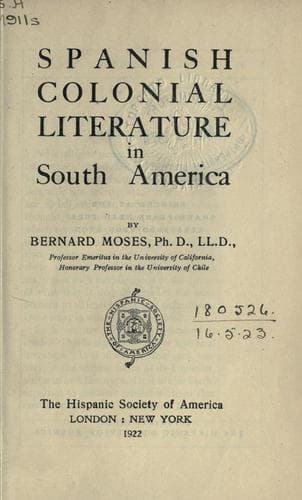
Spanish colonial literature in South AmericaMoses, Bernard
History
Spanish colonial literature in South America
Moses, Bernard
Spanish American literature -- History and criticism
In his _Relación de la conquista del Perú_ Pedro Sancho presented another
contemporary account of the occupation of Peru. By reason of the writer’s
relation to Pizarro the narrative acquired a partisan bias; it was
expected to contribute to restoring the governor to the emperor’s favour.
It was translated into Italian, and appeared in Ramusio’s _Viaggi_,
published in Venice about 1550. An edition in Spanish by Icazbalceta was
issued in Mexico in 1849. A part of Sancho’s document is included in
the already mentioned volume called _Reports on the Discovery of Peru_.
Sancho gives the following account of Pizarro’s distribution of the gold
and silver collected: “He caused all the gold which had been collected
to be melted, which was in small pieces, an operation quickly performed
by Indians skilled in the process. And when the sum total was weighed,
it was found to contain five hundred and eight thousand, two hundred odd
pounds of gold. The fifth for H.M. was taken out, and it was one hundred
and sixteen thousand and seventy odd pesos of good gold. And the same
smelting was performed for the silver, which was found to contain two
hundred and fifteen thousand marks, a little more or less, and of them
one hundred and seventy thousand or so were fine silver in vessels and
plates, pure and good, and the rest was not so, because it was in plates
and pieces mixed with other metals, from which the silver was extracted.
And from all this, likewise, was taken the fifth for H.M. Truly it was
a worthy thing to be seen, this house where the melting took place, all
full of so much gold in plates of eight and ten pounds each, and in
vessels and vases and pieces of various forms with which the lords of
that land were served, and among other very sightly things were four
llamas in fine gold and very large, and ten or twelve figures of women
of the size of the women of that land all of fine gold and as beautiful
and well-made as if they were alive.... There were, besides, other silver
objects of like form. The seeing of great vases and pieces of burnished
silver was certainly a matter of great satisfaction. The governor divided
and distributed all this treasure among all the Spaniards who were at
Cuzco and those who remained in the city of Jauja, giving to each one
as much good silver, and as much impure, together with as much gold [as
he deserved], and to each man who had a horse he gave according to the
man’s merit and that of the horse and in accordance with the services he
had done; and to the peons he did the same according to what was posted
up to his credit in the book of distributions, which was kept.”[16]
III
[Sidenote: Tomás de San Martín]
[Sidenote: San Martín in Charcas & Lima]
Public-domain text, read in full here on John Shaqi.
Reviews
Reviews
No reviews yet
Be the first to share your thoughts on this work.
Join the Discussion
Join the discussion
Sign in to leave a comment or review.
Sign InorCreate an account