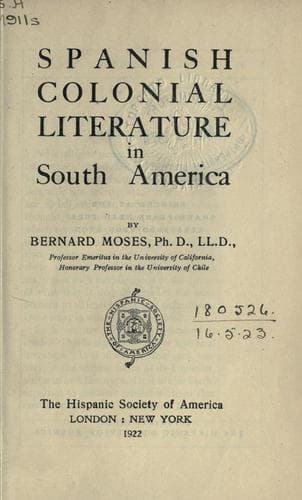
Spanish colonial literature in South America — John Shaqi
Spanish colonial literature in South AmericaMoses, Bernard
History
Spanish colonial literature in South America
Moses, Bernard
Spanish American literature -- History and criticism
An inquiry into the justice of the gains made by the conquistadores was
undertaken by Tomás de San Martín, a Dominican, who played a conspicuous
rôle in Peru during the troubled period covering the last years of
Pizarro’s rule, the introduction of the New Laws, the overthrow of the
first viceroy, and the administration of President Gasca. While not much
has come to light about the birth and parentage of San Martín, it is
known that he took orders in the monastery of San Pablo in Córdoba in
Spain: that he became a lecturer on arts and theology at Seville, in the
college of Santo Tomás; and that he arrived very early in the island
of Santo Domingo, where he laboured as a missionary among the Indians,
exercising whatever influence he possessed to protect them from those who
would reduce them to slavery. In this undertaking San Martín co-operated
with Las Casas. Having returned to Spain, he was appointed by the king
to be a member of the audiencia established at Santo Domingo. This post
he later renounced, and joined a company of ecclesiastics going to
Peru with Francisco Pizarro. He assisted at the founding of Piura and
remained there, while Pizarro went on to Cajamarca, but after the murder
of Atahualpa he rejoined Pizarro and went with him to Jauja. In 1534 he
was sent to the province of Charcas, and thus became one of the first to
preach Christianity in that region.
On the creation of the Dominican province in Peru San Martín became the
Provincial, and from this time until he left America with President
Gasca in 1550, he had part in the affairs of Lima. He was in the town
when Pizarro was assassinated, June 26, 1541, was named by Cristóbal Vaca
de Castro, who succeeded Pizarro, as a member of a commission appointed
by Castro to take charge of the affairs of justice and administration
in Lima, and was instrumental in the pacification of Peru, which was
the object of Gasca’s mission. His part in this work and his known
interest in the affairs of the colonies assured for him an especially
favourable reception by the king, and presentation in 1552 as the first
bishop of Charcas. He returned to Lima two years later and died there in
March, 1554. A memorial in which he discussed the acquisitions of the
conquistadores was published in Madrid.[17] Among San Martín’s writings
we find also an account of the sacrifices made by the ancient Peruvians
to their gods at seed-time and harvest, as well as on the occasion of
undertaking public works.
[Sidenote: Peñalosa on Spaniards]
Public-domain text, read in full here on John Shaqi.
Reviews
Reviews
No reviews yet
Be the first to share your thoughts on this work.
Join the Discussion
Join the discussion
Sign in to leave a comment or review.
Sign InorCreate an account