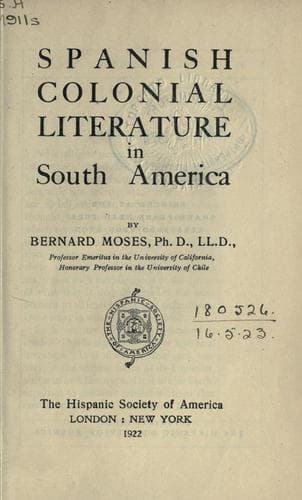
Spanish colonial literature in South AmericaMoses, Bernard
History
Spanish colonial literature in South America
Moses, Bernard
Spanish American literature -- History and criticism
Like Las Casas and San Martín, other persons questioned the pretended
right of the Spaniards to rob and destroy the Inca kingdom, and when
these views were expressed they naturally provoked a reply. Such a reply
was undertaken by Benito Peñalosa Mondragón, a Benedictine monk, in a
book entitled _Libro de las cinco excelencias del español_ (1629). One
of his arguments consisted in showing that great riches were acquired
by the Spaniards from the colonial possessions, from the mines of gold
and silver and mercury, and from various other sources; but it is not
conceived that men like Las Casas and San Martín would be greatly moved
by Peñalosa’s views.
IV
[Sidenote: Pedro Pizarro’s book]
Another account of the conquest of Peru is that by Pedro Pizarro, who
went to America as a page to Francisco Pizarro in 1530, and remained
with him until the governor’s assassination. He afterwards settled in
Arequipa, and, in 1571, completed his _Relación del descubrimiento y
conquista de los reinos del Perú_. This work has been characterized as
“the narration of a rough half-educated soldier, and occupies much the
same place in the history of the conquest of Peru as the work of Bernal
Díaz does in that of Mexico.”[18]
[Sidenote: Molina of Santiago]
Cristóbal de Molina’s narrative of the conquest long remained in
manuscript, and the writer was confounded with another author of the same
name. They are now distinguished by calling this one Molina of Santiago
and the other Molina of Cuzco. Molina of Santiago was born in Spain,
travelled in that country, Italy, and Flanders, and went to America at
the age of forty-one. The circumstances of his education and entry upon
the religious life are unknown; but we are informed that he was in Santo
Domingo in 1532 and at Panama in April of the following year. While
at Panama he joined an expedition designed to take reinforcements to
Pizarro, but by ill fortune the expedition was obliged to halt at the
river San Juan, whence after a period of forty days the members returned
to Panama. Molina went to Santo Domingo and later to Spain to carry news
of Pizarro’s discoveries. He remained only a short time in the Peninsula,
and in 1535 he was again in America, where, in July of that year, he
joined Almagro at the battle of Salinas. Molina went from Cuzco to Lima,
and from the latter city he wrote to the king, on the twelfth of June,
1539, setting forth the dangers he had encountered and the losses he
had suffered in the royal service. Twelve years afterwards he took part
in the Chilean campaigns of García Hurtado de Mendoza. Later he became
attached to the cathedral at Charcas, lived in Lima, and finally returned
to Chile, where he died as a priest in Santiago.
[Sidenote: Molina’s _Conquista_]
Public-domain text, read in full here on John Shaqi.
Reviews
Reviews
No reviews yet
Be the first to share your thoughts on this work.
Join the Discussion
Join the discussion
Sign in to leave a comment or review.
Sign InorCreate an account