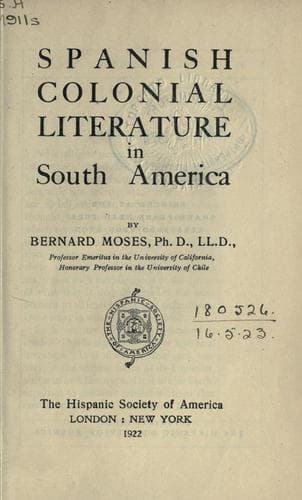
Spanish colonial literature in South AmericaMoses, Bernard
History
Spanish colonial literature in South America
Moses, Bernard
Spanish American literature -- History and criticism
The agencies of control in the colonial undertaking, whether military,
ecclesiastical or civil, were directed from Spain. These agencies, in
their final organization, were gathered into three important groups,
or viceroyalties: Peru, New Granada, and Río de la Plata. The viceroy
in each of these semi-independent states was assisted by a small body
called an audiencia, which performed the functions both of a ministry
and of a supreme court. In the several subdivisions of the territory
local officers, known as corregidores, carried on a practically arbitrary
administration, under which the Indians were oppressed and impoverished;
and in the larger town a cabildo, or municipal council, exercised a
certain degree of control, when not impeded by a superior authority.
Over the government and the inhabitants, in the course of time, the
Inquisition extended its paralysing force; and in the presence of spies
and malicious reporters men put off their intellectual independence,
and either remained silent or conformed their utterances to the
prescriptions of the Holy Office. This restraint naturally limited the
range of ideas that found expression either orally or in writing. Authors
had continually to face the possibility of seeing their manuscripts
refused the privilege of publication. The subjects not liable to this
embarrassment were the history of the colonies discreetly treated, the
geography and natural history of the Indies, and the doctrines and
history of the Church. Writings on these subjects, therefore, constitute
the bulk of the colonial literature of South America.
[Sidenote: Writings in verse]
Nature as displayed in the unspoiled wilderness of the New World
attracted more attention than it had received in Spain, and writers
of the history of the Indies gave much space to descriptions of
their unfamiliar environment. Great writers of Italy had made verse
a preferred form of literature in the sixteenth century, and there
is no doubt that, in addition to their example, the exaltation of
spirit maintained by the unaccustomed adventures of early colonial
life contributed powerfully to the extensive adoption of this form of
utterance. It was undoubtedly the new and inspiring scenes and events
attending the campaigns against the Araucanians that moved Ercilla to
give a poetic record of his experience, in _La Araucana_. When Barco
Centenera under similar influences undertook to write an account of the
Spanish occupation of the south eastern part of the continent, the result
was an “historical poem” called _La Argentina_; and Peralta Barnuevo’s
extended history of the early development of Spanish society in Peru
assumed the metrical form in _Lima fundada_. The form of Castellanos’
chronicle was practically determined by the success of Ercilla’s verses.
And after these came a troop of chroniclers, whose verses were the
product of imitation rather than the result of original inspiration.
[Sidenote: The question of printing]
Public-domain text, read in full here on John Shaqi.
Reviews
Reviews
No reviews yet
Be the first to share your thoughts on this work.
Join the Discussion
Join the discussion
Sign in to leave a comment or review.
Sign InorCreate an account