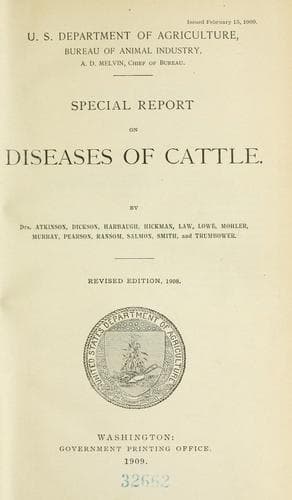
Special report on diseases of cattleUnited States. Bureau of Animal Industry
Science
Special report on diseases of cattle
United States. Bureau of Animal Industry
Cattle -- Diseases
the poisoning will be found varying all the way from fatality to
imperceptibility.
GENERAL SYMPTOMS OF POISONING.
It is not always easy to differentiate between poisoning and some disease.
Indeed, examination during the life of the animal is sometimes wholly
inadequate to the formation of an opinion as to whether the case is one of
poisoning or, if it is, as to what the poison may be. A chemical and
physical examination after the death of the animal may be necessary to
clear up the doubt. On the other hand, the symptoms may be of such a nature
as to point unmistakably to poisoning with a certain agent. In general, the
following classes of symptoms may be regarded as indicative of poisoning:
Sudden onset of the disease without visible cause, a number of animals
being similarly affected at once, with severe gastrointestinal disorder or
derangement of the nervous system, or both; sudden alteration of heart
action in relation to frequency, force, or rhythm; local irritation,
dyspnea, or change in the urine or urination.
After death, lesions of the greatest variety may be found, and it is
necessary for one to be skilled in anatomy and pathology in order to
determine their significance. Oftentimes the stomach and intestines are
red, have thick walls, and contain blood. This signifies a severe irritant,
such as arsenic or corrosive sublimate. Other alterations sometimes found
are inflammation of the kidneys or bladder, points of hemorrhage in various
organs, changes in the blood, congestion of the lungs, and certain
microscopic changes.
GENERAL TREATMENT.
Public-domain text, read in full here on John Shaqi.
Reviews
Reviews
No reviews yet
Be the first to share your thoughts on this work.
Join the Discussion
Join the discussion
Sign in to leave a comment or review.
Sign InorCreate an account