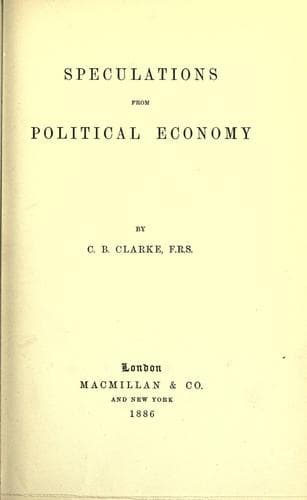
Speculations from Political EconomyClarke, Charles Baron
General
Speculations from Political Economy
Clarke, Charles Baron
Economics
Thirdly, The fall in the price of tea and beer would bring down
the price of all competing drinks: it would at first diminish the
consumption of competing drinks. The cheapening the price of some of
the prime necessaries of life would be to some extent divided between
capital and labour. As in the case of wheat, the labourer would be made
better off, while the profits of capital would be raised. A general and
permanent improvement in all trades would result, except possibly in
those of the tea-dealer and brewer--but I do not think they would lose.
I see no end to the developments from Universal Free Trade: we can only
gain some idea of what they would be by tracing as far as we may what
the results of Free Trade in one article--wheat--have been; and in doing
this we must recollect that before 1846 the quantity of wheat imported
was trifling compared with the present importation.
To this scheme of direct taxation Edward Wilson objects, "Taxation
should fall on expenditure, not on income." It is true that our object
must always be to encourage accumulation, and discourage destruction
of capital (expenditure). Practically, it does not appear that a heavy
income tax diminishes the taste for accumulation in England: it does
increase the tendency of large capitalists to invest their capital out
of England, so as to avoid the State charges on capital in England.
But the capital in England and the quantity of English capital invested
abroad are already so enormous that the "tendency" of an increased
income tax may be disregarded. Lastly, it may be objected, Would the
sixteen-pence income tax levied as you propose (or nearly so) raise
£40,000,000? At the time of the Crimean War each penny in the pound
income tax brought in a million sterling. At the present time, each
penny in the pound income tax brings in nearer two millions sterling,
but the productiveness of the tax is much interfered with by the large
remissions now allowed, and subtractions which take effect just where
the contributors to the tax are most numerous, say from £100 to £300
a year. I therefore reckon that, without remissions, the tax of
sixteen-pence in the pound down to £156 a year would produce about
£30,000,000, and that the tax down to £52 a year would about produce
the rest. The _total_ income that income tax is now levied on is nearly
£600,000,000. We need not be surprised at the productiveness of the
income tax. A man of £10,000 a year pays tax on that. But he has a
steward on £300 a year, he is worth to his firm of lawyers £100 a year,
and so on: these pay income tax on the £300 and the £100 over again.
When the income tax is carried down to incomes on £1 a week, the
tax will be levied on the same income over and over again. Even a
spendthrift with £10,000 a year usually scatters more than he actually
destroys.
Public-domain text, read in full here on John Shaqi.
Reviews
Reviews
No reviews yet
Be the first to share your thoughts on this work.
Join the Discussion
Join the discussion
Sign in to leave a comment or review.
Sign InorCreate an account